Now leaving ThriventFunds.com


You're about to visit a site that is neither owned nor operated by Thrivent Asset Management.

In the interest of protecting your information, we recommend you review the privacy policies at your destination site.

Financial Professional Site Registration

Complete this form to get full access to the entire financial professional site.

By clicking “Register”, you agree to our privacy and security policies and that you are a financial professional.

Access will be granted immediately, but the registration process may take up to 5 business days to complete.

Thank you for registering

You can now enjoy all financial professional content.

If your download does not start automatically, click here.

An error occurred

Please check back later.

CAPITAL MARKETS PERSPECTIVE: NOVEMBER 2026

Bonds rally on AI anxiety

11/06/2026


Key points

Economic impact

Interest rates are unlikely to rise much further or fall quickly.

Market

Investors may want to consider rotating from cash to Treasuries and/or corporate bonds.


WRITTEN BY:
Chief Investment Strategist
WRITTEN BY:
Steve Lowe, CFA,Chief Investment Strategist

Thrivent Asset Management contributors to this report: Kent White, CFA, head of fixed income mutual funds; David Spangler CFA, head of model & mixed asset portfolios; and John Groton, Jr., CFA, director of administration and materials & energy research


Key points

U.S. economy remains robust

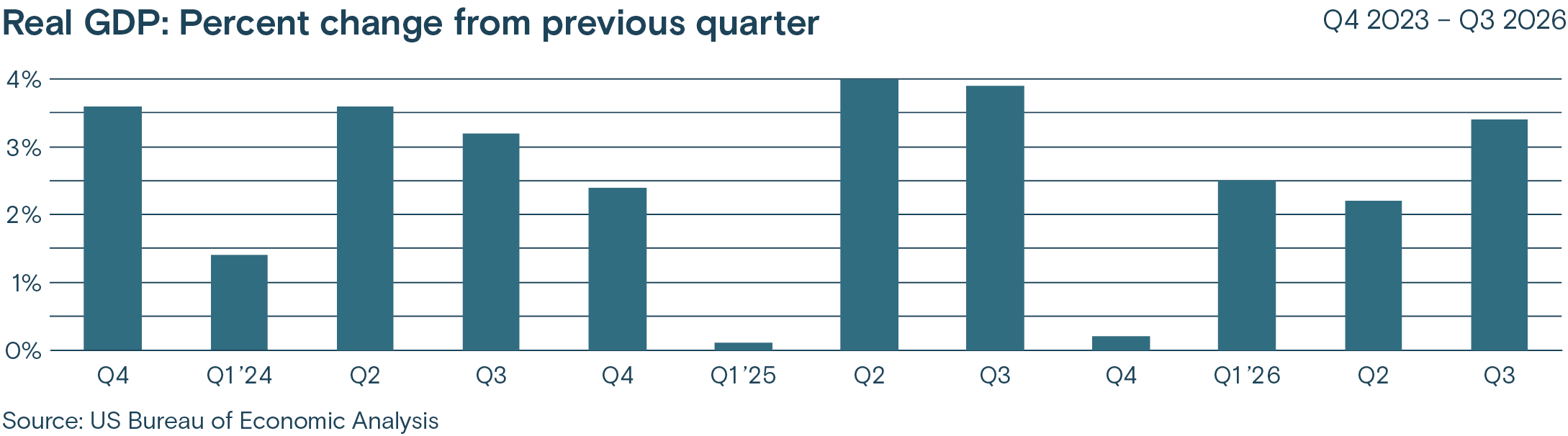
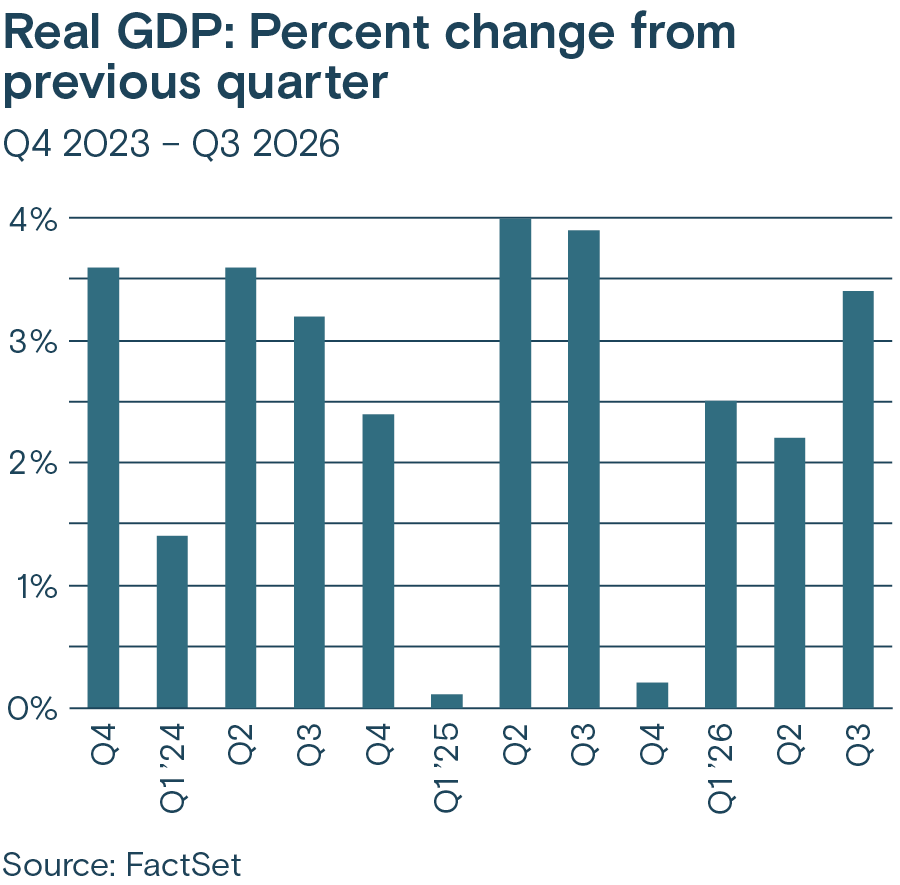
Third-quarter GDP rose 3.4%, supported by the large investment cycle in AI and resilient consumers.

Stocks wobble

The S&P 500 Index declined modestly as investors questioned the return on AI investment while more conservative sectors like consumer staples outperformed.

Treasuries rally

After surging higher in September, the more attractive yields increased demand for high-quality securities that could provide a hedge against equity weakness.


Economy: Third-quarter U.S. gross domestic product (GDP) grew 3.4%, the economy’s fastest rate in a year, supported by the ongoing investment cycle in artificial intelligence (AI) and persistent consumer spending. October’s employment report showed job growth was much higher than expected, while August and September estimates were revised higher. The unemployment rate dropped to 4.1% in October, and wage growth picked up. The combination of robust economic growth and persistently high inflation is expected to compel the U.S. Federal Reserve (Fed) to progressively raise interest rates to combat inflation.

We expect U.S. economic growth to remain healthy and capital spending for AI to remain a driving force. As such, any slowdown in AI-related investment would likely have a correspondingly negative impact on economic growth. Additionally, the ongoing conflict in the Middle East and the path of inflation and interest rates remain risks.

Stocks: The S&P 500® Index fell 0.93% in October, bringing its year-to-date return to 10.73%. Communication services and information technology led the market lower as investors reevaluated companies’ investment in AI. Sales growth among AI leaders has been rapid, but it remains unclear whether they will be able to monetize it sufficiently to sustain strong earnings, or whether competition, including AI models emerging from China, will erode their pricing power.

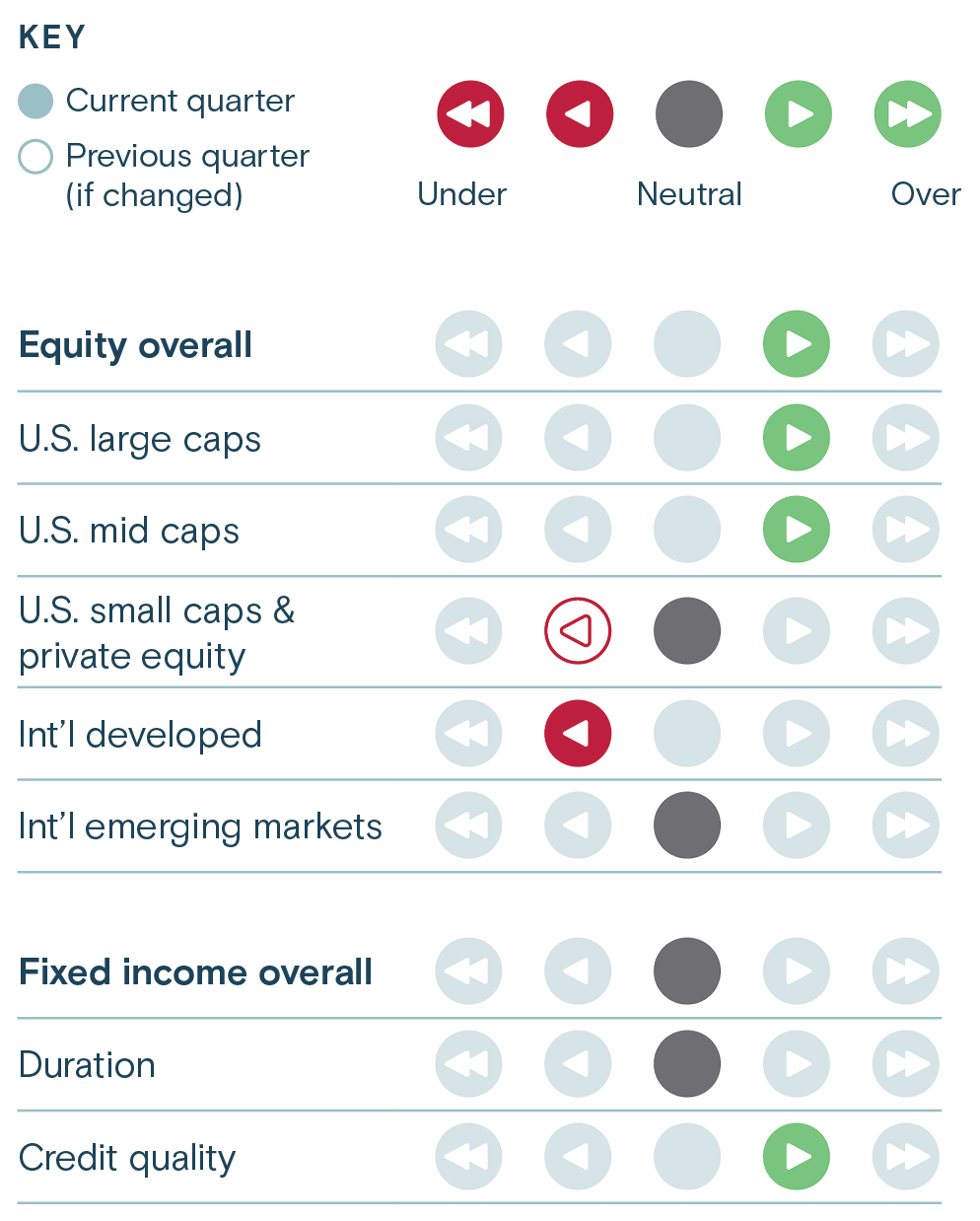
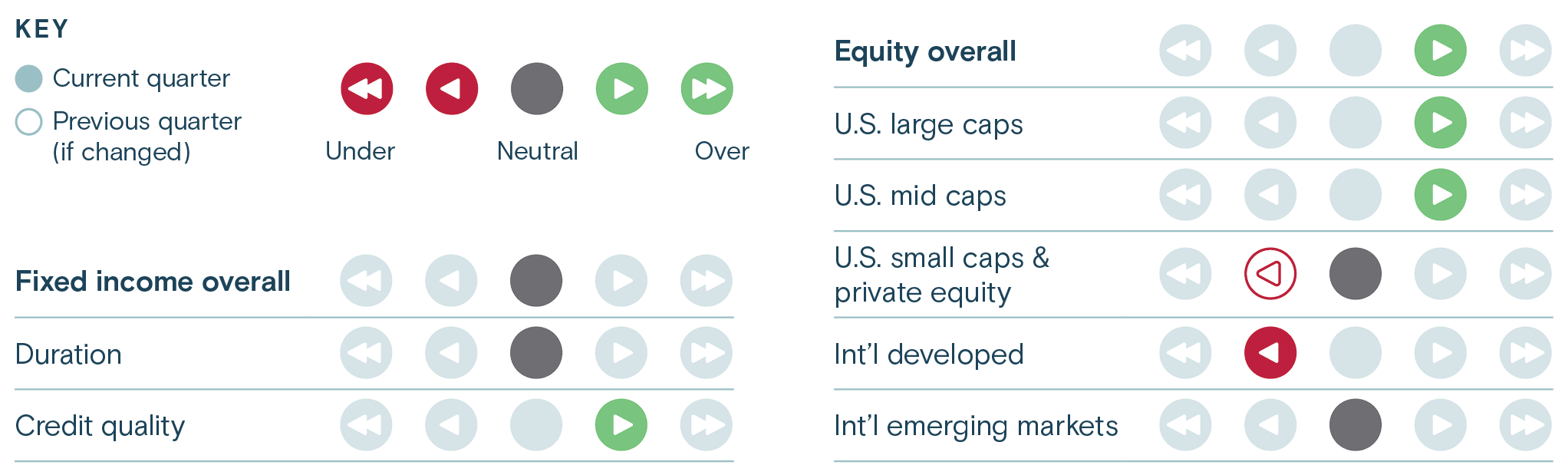
We remain modestly overweight U.S. equities and overweight large-cap stocks. Including our private equity allocations, we are roughly neutral to small-cap and mid-cap stocks. We continue to be underweight developed international stocks and neutral emerging markets. While we have growing concerns that AI revenues may not meet current expectations, we would look to add marginal exposure to secular growth stocks at more attractive valuations should equities fall significantly.

Bonds: The benchmark 10-year Treasury yield fell more than 0.38% in October. The Federal budget deficit remains an ongoing concern as U.S. debt relative to GDP recently breached 100%, its highest level since 1946. However, equity market volatility and attractive current yield levels for Treasuries and investment-grade corporate bonds increased demand for these instruments, driving yields lower. The Bloomberg U.S. Aggregate Bond Index, which includes Treasuries and investment-grade corporate bonds, rose 2.44% in October.

We remain roughly neutral in our interest-rate exposure, with a small overweight in longer-dated Treasuries. We expect interest rates to remain higher than they have been in the past 25 years given solid growth, high inflation and persistent concerns about debt levels. While these risks remain, yields are still relatively high and Treasuries’ ability to act as a hedge if equity markets sell off significantly makes them an attractive holding in the current environment. We continue to see value in investment-grade corporate bonds, despite increasing new issuance to fund investment in AI.
November highlights

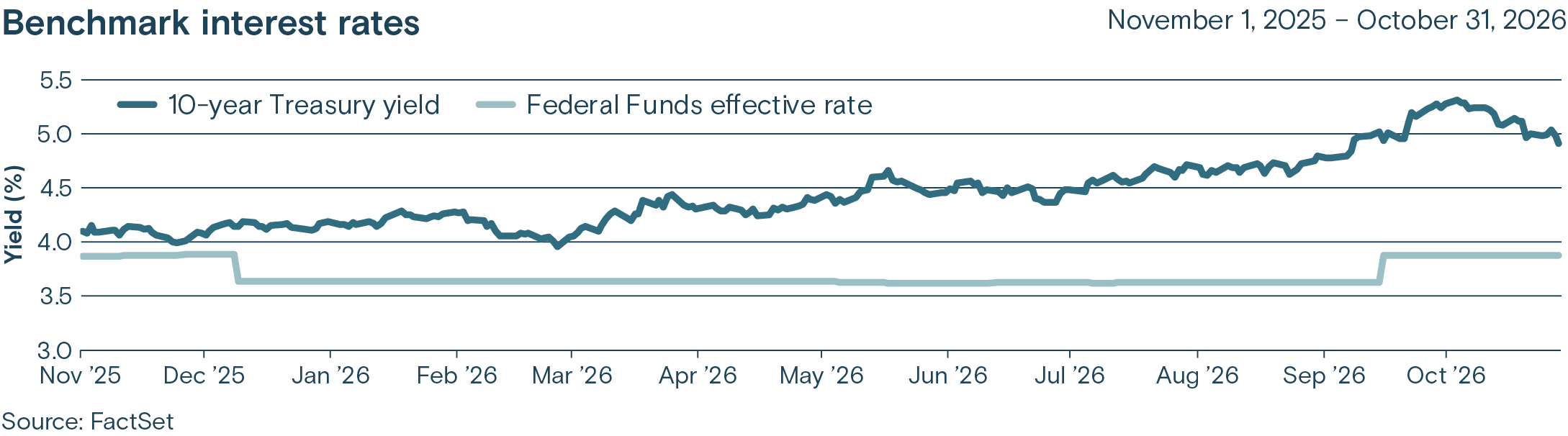
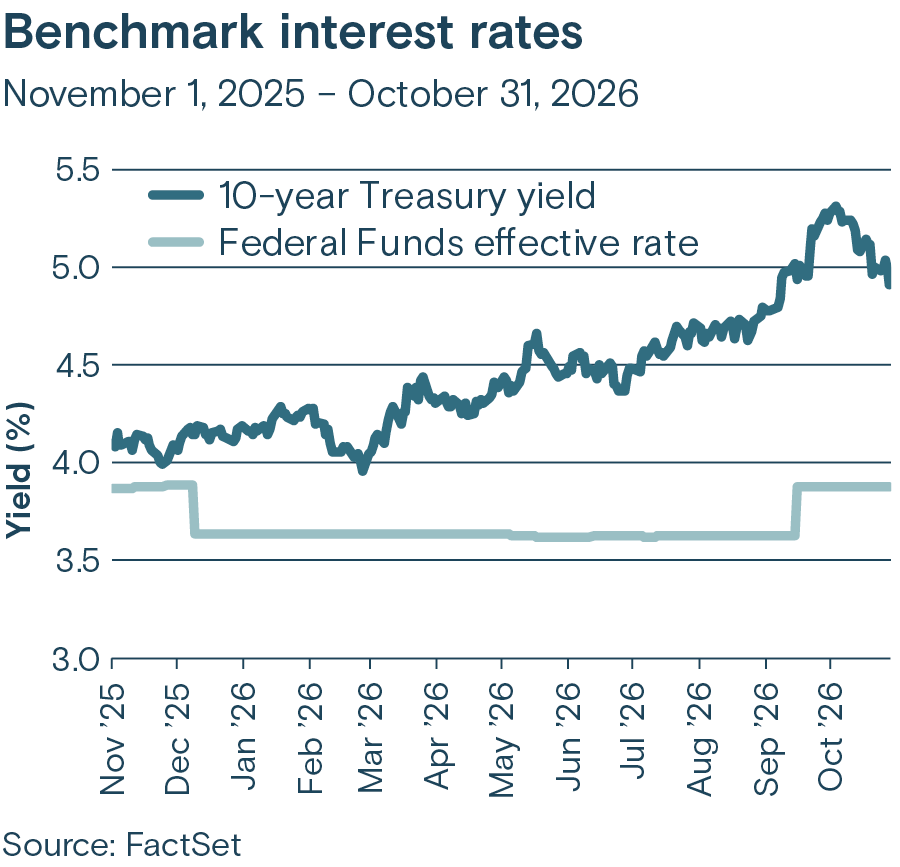
This line graph tracks two benchmark interest rates, the Federal Funds effective rate and the 10-year Treasury yield, from November 2025 through October 2026.

The benchmark 10-year Treasury yield began rising steadily in early March and surged higher in September. October’s strength has been attributed to demand for high-quality, investment-grade bonds given absolute yields not seen in decades. After raising interest rates by 0.25% in September, the Fed kept rates unchanged at its October meeting. Looking ahead, markets expect the Fed to raise rates again before year end and to continue raising rates in 2027, absent a significant deterioration in economic data or a meaningful slowdown in inflation.

This bar chart shows the real GDP percent change from the previous quarter, Q4 2024 to Q3 2026

The U.S. economy has proven resilient over the past few years, despite many internal and external shocks. In 2026, significant trade disputes and the current conflict in the Middle East have weighed on economic activity, but a surge in AI-related capital spending has more than offset those effects. While risks and challenges remain to future economic growth, including higher interest rates, we expect consumer resilience and AI-driven investment spending to continue to sustain economic growth in the quarters ahead.

Overall views

Asset class weighting

This graphic illustrates Thrivent Asset Management's asset class weighting for the current quarter for fixed income and equity.

Asset class weighting

This graphic illustrates Thrivent Asset Management's asset class weighting for the current quarter for fixed income and equity.

Media contact: Callie Briese, 612-844-7340; callie.briese@thrivent.com

All information and representations herein are as of 11/06/2026, unless otherwise noted.

The views expressed are as of the date given, may change as market or other conditions change, and may differ from views expressed by other Thrivent Asset Management, LLC associates. Actual investment decisions made by Thrivent Asset Management, LLC will not necessarily reflect the views expressed. This information should not be considered investment advice or a recommendation of any particular security, strategy or product. Investment decisions should always be made based on an investor's specific financial needs, objectives, goals, time horizon, and risk tolerance.

The Federal Funds effective rate is the interest rate at which depository institutions (mainly banks) lend reserve balances to other depository institutions overnight on an uncollateralized basis. In simpler terms, it's the rate banks charge each other for short-term loans to meet their reserve requirements.

Any indexes mentioned are unmanaged and do not reflect the typical costs of investing. Investors cannot invest directly in an index.

Past performance is not necessarily indicative of future results.

Related Insights