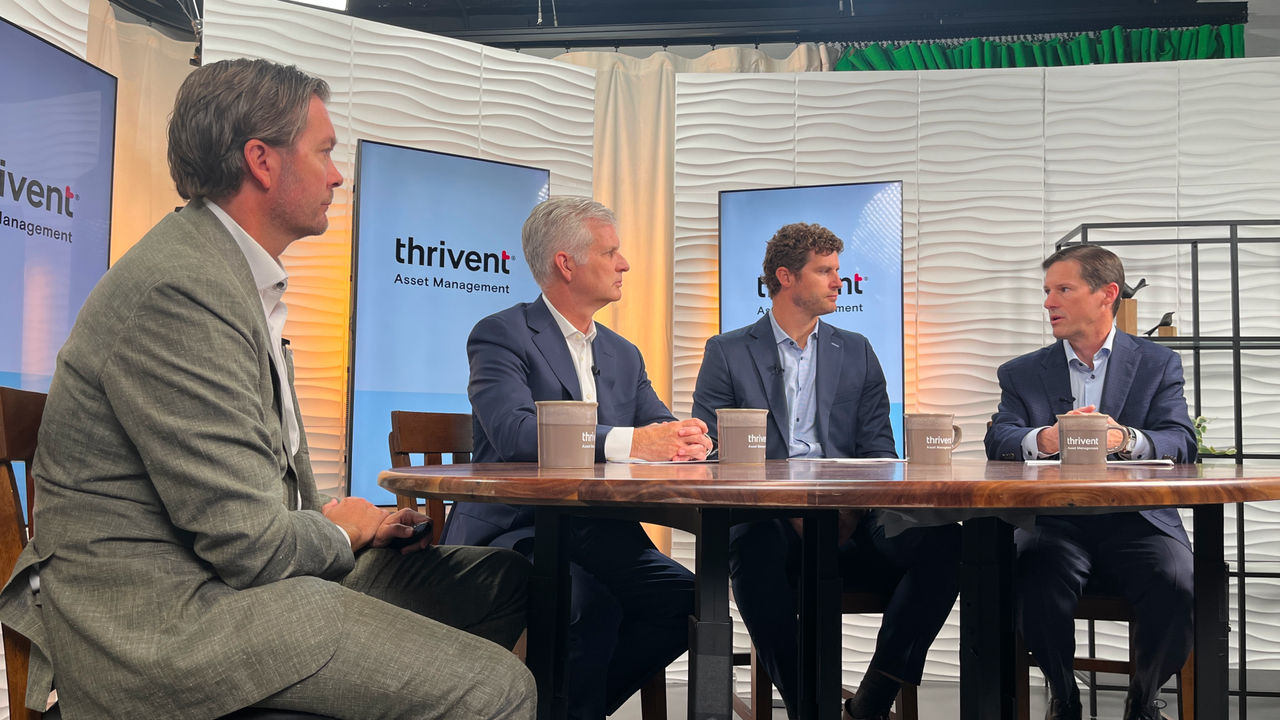
Dan Chouanard: Good afternoon, everyone, and welcome to our webinar on fixed income opportunities in a rising rate environment.
I'm Dan Chouinard, Head of Investment Sales and Distribution at Thrivent Asset Management. And with me today are Kent White, Head of Fixed Income, and Courtney Swenson, Senior Portfolio Manager. Welcome, Kent and Courtney.
Kent White: Thank you.
Cortney Swensen: Thanks, Dan.
Chouanard: So first, let me give you a little background on Kent and Courtney. Kent is a CFA, Head of Fixed Income and Portfolio Manager on Thrivent Core Plus Bond, Government Bond, Income Fund, which is our corporate bond strategy, and has over 27 years of industry experience.
Cortney is also a CFA, a Senior Portfolio Manager on Core Plus Bond as well, Income Fund, Short Term Bond, Ultra Short Bond, and has 21 years of industry experience.
So, you can see we have a wealth of knowledge and experience here at the table today to talk about fixed income and the opportunities in ‘27.
Also, I just want to bring to everybody's attention, Thriving Asset Management has extensive experience in managing fixed income solutions, which you can see on the chart in front of you. So, with that, maybe what we'll do is we'll start with Kent. Kent, yields and fixed income have increased significantly this year. What's been this big move?
White: Yeah, it's definitely been another interesting year in fixed income. So, just to frame things up for our conversation today and to recap 2026 a bit, yields across the Treasury curve and almost every fixed income asset class have reached levels that we haven't really seen in over two decades.
On the slide that you should be able to see right now, you can see 10-year Treasury yields have not been this high since 2002. So, this move higher has been driven by three or four main factors, the largest of which has been the impact from persistently high inflation, and most of which this year has been from higher energy prices due to the war in Iran.
Treasury yields and oil prices have been very highly correlated, and we've begun to see some feed-through or pass-through of high energy prices from really high diesel prices and fertilizer costs begin to show up in the rest of the supply chain. So that's something the Fed is definitely keeping an eye on and has had an impact on inflation and yields.
More recently, though, surprisingly strong GDP growth has been contributing to higher rates. GDP growth is likely to be over 3% in the third quarter, which will be reported soon. And a lot of this strength is coming from the huge expenditures for the AI buildout that we've been seeing.
But it's also been coming from a very resilient consumer that is still spending, even through these higher rates and higher energy prices. A little surprising there.
Chouanard: So how about other developments outside the U.S.? How have those impacted yields today?
White: Yeah, so those have actually had a recent impact on yields, the recent move. We're seeing yields move a lot higher in Japan, France, the rest of the Eurozone, the UK and the common denominator there is really large fiscal imbalances that have put an upward pressure on rates there.
And it's not just overseas, it's here in the U.S. too. We have our own fiscal issues that we need to work through and all of that is combined to put further pressure up on yields across the fixed income.
And then finally, the latest leg higher, released in the last two months, has been driven by a much more hawkish Fed and their path for future rate hikes that they've been talking about. So not only has new Fed chair Kevin Warsh sounded more hawkish, at least in the last FOMC meeting, the Federal Open Market Committee, but the rest of the committee has also—it's been more hawkish as well. We had a unanimous vote to raise rates in September and with broad support for further rate hikes.
Chouanard: Great. All right. Well, kind of keeping on that tone, what has been the impact of higher yields on performance and returns this year?
White: Right. Okay, so all the factors I just mentioned have combined to put upward pressure on interest rates this year. And because bond prices go down when rates are rising, total returns have been moderately negative year to date.
If you look at the total return for the Bloomberg Aggregate Index, which is the main bond index that fixed income looks at, year to date, it's down roughly 1.75%.
However, funds like the Thriving Ultra Short or the Thriving Short-Term Bond Fund, they have lower duration risk, which is a way to measure interest rate sensitivity. Those funds have actually had positive returns year-to-date. So, it depends on where you're at on the curve.
So, another point I like to make, too is just it's really important to make sure your clients differentiate between price returns and total returns when they're looking at their statements. They may be focused on the price return, which might not include the income component that they're generating from these investments. And it could be a meaningful difference when you're looking at that. And income is the critical component of fixed income investing right now. So, you can't ignore that part.
Chouanard: And I would even add to that for most clients, I think a lot of times when they look at their statement, they see a number of shares and they see a NAV price and then a value. And a lot of things they don't understand is that yield that's very high at this stage of the game is kicking off monthly or quarterly, most of the time monthly. And most people, we know from the data, over 70% reinvest those dividends or yield off those bonds in their bond funds and ETFs. And so it buys more shares. So, their share prices go up. Maybe the NAV stays the same, but it also raises the cost basis of the holding itself. So, sometimes it can show like a negative number and it's not real if you kind of factor in what you started with the investment. So, that's something to keep in mind as you kind of look at your bond performance.
Cortney, maybe we'll shift gears a little bit. As investors assess the path of inflation, U.S. Federal Reserve policy, government borrowing needs, what are the most important factors that could influence interest rates?
Swensen: Yeah, let's start with the Fed, Dan. So, we began this year expecting the Fed to cut rates. And here we are now in October with one rate hike behind us and the market pricing in another three hikes in the next 12 months.
Unemployment has been under 4% for almost five years now. And so, the Fed really just isn't worried about the job side of their mandate. They made that pretty clear in their last couple of meetings.
But increasingly, they are focused on the inflation trends. As we all know and we feel in our daily lives, we've been above our 2% target for more than five years. We saw a lot of disinflation between 2022 and 2024 when inflation was falling after COVID, but it's stalled out over the last couple of years and it's even crept higher over the last year. Core PCE, which is the Fed's preferred measure of inflation, is just kind of stuck around 3%.
The September meeting, as Kent mentioned, was hawkish. They raised rates unanimously. Fed speeches after that point played down the hiking narrative a bit. So, the market's trying to figure out what the Fed will do. Last week, the September CPI number came in above consensus, and it’s running at 2.6% year over year, which crept up from 2.4%. So, it's kind of going in the wrong direction.
The Fed meets next Wednesday, of course. We think it could be in play. Chairman Warsh has made it clear that he wants every meeting to be live. They did start their hiking cycle already, so they could, even though the midterms are coming up, they could hike next week. If they don't hike next week, I mean, people were thinking for surely they will go in December. We will not have any data before that, the next meeting.
Chouanard: Great, thank you. So, let's kind of maybe discuss the influences on the yield curve. So maybe, Cortney, you can kind of take a look at that. I think everybody can see a Treasury yield curve on your screen, hopefully at this time.
Swensen: Yeah, so we think about the yield curve in segments. The short end of the yield curve is what we consider to be inside of five years. It's highly influenced by Fed action, the perceived path of monetary policy. And most of that increase year to date has been from energy prices feeding through from the Iranian war.
The long end, however, the 30-year in particular, is much more driven by GDP growth. So, this is kind of the equity-like part of fixed income. GDP growth has been coming in stronger than expected.
Also, what's going on across the curve, but most significantly beyond five years, is really a competition for capital. We are seeing this all over the place. There's just insatiable want for issuance. Governments around the globe are running large fiscal deficits as they're dealing with their aging populations. And then of course the AI cap-ex cycle, which gets a lot of attention, has ramped up significantly this year and is only projected to increase into the end of the decade, potentially needing trillions in capital.
Chouanard: Great. And you and I were talking the other day, kind of the interesting part, and I'm not sure if that yield chart is still available to the audience, but when you look at the yield chart, it ends at the 3-month, not the Fed funds rate. And so what did you call out some things to me the other day about the Fed funds rate? Maybe kind of enlighten everybody on that topic.
Swensen: So, I was looking back. We work in markets, so we're always kind of thinking ahead and the markets are trying to price in what will happen. So, it was instrumental to go back and look at where we were a year ago with across the curve and actually Fed funds was at the exact same rate that it is today, even though it really has a much different feeling, of course, and the shape of the curve is in a much different place.
Chouanard: Yeah, and so as that curve widened, I think the chart showed like December of of ‘25 versus September of ‘26, not even a full year. That big movement is obviously when the interest rates go up, bond prices go down, hence people are feeling a little bit of negative returns in the fixed income. But the Fed Funds rate didn't move an inch. With that... .
Swensen: Well, actually, Dan, it went down in December and then they hiked it in September. So, we kind of round-tripped.
Chouanard: Maybe we'll shift gears. Kent, why is fixed income attractive now?
White: Yeah, I mean, it really gets back to the income component of fixed income right now. As we mentioned earlier, yields haven't been this high in over two decades. So, yields from 5.5 to 6% across every fixed income asset class are very attractive to us right now. One way to look at these yields and why they're more attractive is to actually do a little bit of bond math, and that might clarify things a little bit, what we've been talking about.
Let's say the duration of a portfolio is roughly 5 1/2 years. And what duration does is it measures the interest rate sensitivity to a bond or a bond portfolio. So, 5 1/2 years, that's about the duration of the Corp Plus Bond ETF that Courtney manages. If rates were to go up 1% from here, since the duration is 5 1/2%, I'm sorry, is 5 1/2 years, the price return would be negative 5.5%.
So, if you're looking at that negative 5.5% return, the other thing you have to consider is the income piece. So, the SEC yield for the Core Bond Plus ETF right now as of 9/30/26 was 5.34%. So, you're almost breaking even at those yields over one year if rates were to go up another 1%.
So, basically, you have a yield cushion now that protects you from further price declines. And that's why we find fixed income more attractive at these levels than we did earlier.
Now the opposite case, that if yields would actually decline 1%, say for example in a weaker economic environment where the Fed might be cutting rates again, your one-year total return would then be 10.5%, so the yield of 5.34 plus the 5.5% price return. So, that's a really attractive return if things go south. So, the upside/downside scenarios at these yield levels are pretty compelling.
Chouanard: Yeah, so it sounds like from what you're saying, it's like due to the fact that if let's say the 10-year Treasury moved up 50 basis points, there's a lot less risk on the upside for the price of depreciation in the bond. But if the interest rates fell at 1%, there'd be a lot of opportunity for bond return.
White: Right, exactly.
Chouanard: Great. So, Kent, maybe kind of the next step would be like over the past decade, many investors question the value of bonds in a portfolio. With higher correlations in the past few years between equity and fixed income, what role do you see fixed income playing in an advisor model client portfolio?
White: Yeah, so they were right to question that. The last few years haven't really, it hasn't really worked, basically. And the past decade really hasn't been great for fixed income returns. During most of that period, though, 10-year Treasury yields were stuck in a range of about 2 to 3%, and we even got below 1% during COVID in 2020. Since then, we've been in a period of rising rates, which as we walked through is negative for price returns.
But now, as I just walked through, the rate environment has changed quite a bit. So, the short answer to that question is, again, the income component. The income component just wasn't there for most of the past decade. And now that it is, it's a much more compelling allocation because you've got that cushion.
So, besides providing that income cushion, the traditional role of fixed income in a diversified portfolio has been a hedge against a declining equity market. And correlations between equity and fixed income have historically been negative. So, when you have a large equity market drawdown, there's a flight to safety bid to the Treasury market or other fixed income, and fixed income acts as a buffer to those negative drawdowns.
Sometimes there are environments, though, where that relationship breaks down, and we saw it most recently in 2022 when both equities and fixed income fell pretty sharply as the Fed raised rates aggressively to fight inflation. So, there are some periods of time, and that's the one that probably people remember most, because it's just four years ago, where it doesn't work.
So, that's the common denominator there. The Fed is raising rates. The equity market doesn't like it when the Fed is raising rates. And obviously it impacts bond returns too. So, there's periods of time where that doesn't work. And I don't think that we're in that position right now.
Chouanard: And so really for everyone out there, I mean, I think the biggest thing to walk away with that is obviously there's much more volatility in equity returns versus fixed income returns. And pairing together, that's a whole part of diversification is pairing these two different forms of volatility will help dampen the overall volatility for a client. And obviously that's going to make them feel much more comfortable as they look at their statements.
So, with that, maybe we'll kind of shift over to you, Cortney. Given the backdrop of higher yields and fixed income, how does that change the opportunity set for investors seeking income, total return? And then the second part of that would be, are investment grade corporate bonds attractive?
Swensen: Yeah, so I'll start with the investment grade corporate bonds. Corporate bond spreads, so the spread that you earn over your like maturity Treasury, they're not rich anymore. They're quite rich for a while, but they're kind of on the tight end of historical. However, we're still relatively constructive on the asset class. And the reason for this is that fundamentals remain healthy for corporations.
GDP growth is pretty strong at 2 to 3%. There's been a concern about the consumer for a few years now due to inflation pressures. We've been talking about the consumer for a long time. I remember in 2023 specifically being like, when's the consumer going to break? But they've been resilient. They don't like inflation. There's a lot of talk about it, but they still continue to spend, especially in the higher income brackets.
So, corporate profits have held up. They've maintained solid margins. They've had pricing power. And most importantly for credit investors, balance sheets remain healthy, similar to consumers when we had that ultra-low rate environment, corporations refinanced their debt and extended maturities when they had that opportunity. So, they have more cushion now.
So, valuations, overall valuations, meaning yields on the investment grade corporate index are pretty attractive at around 6%. These are the highest we've seen since late 2023, and we only saw those yields for a couple of months before they weren't on offer anymore.
So these are compelling yields for investors that, back five years ago, you really had to go down in the risk spectrum in order to get these higher yields. And now we don't need to anymore, which is a great thing because investment corporates are a high quality asset class with a very low risk of default and you still do get a pickup to Treasuries.
Chouanard: Great. So maybe let's shift to short duration, Cortney. With short-term rates elevated, some investors are asking whether they should stay in cash. What factors should investors consider when comparing money market funds to short duration strategies?
Swensen: Yeah. Investors have been over-allocated to cash for a very long time. There's $8 trillion in money markets right now. It's been that way for many years. And so, as we already talked about, a year ago, the Fed funds rate was at the same level as today, but unlike today, in order to extend out the curve, as you can see on the yield chart, you had to give in yield.
So, the 2-year Treasury was sitting around 3.5% at that time, a year ago. Today, with the market pricing and hikes, the 2-year is around 4.7% as of this morning. So, while the very front end remains anchored around that 4%, just under because of the Fed funds, you can get paid more to extend out the curve.
So, while cash does provide obviously a lot of stability and liquidity, investors can now pick up meaningful yield by just modestly extending out the yield curve.
And so, the other thing I would note about this is that since the market is expecting more hikes, the market seems to be expecting more hikes than the Fed does, just based on kind of their Fed speak, as we say. But the Fed has been wrong about inflation for a while.
So, will the Fed be right this time? We'll see. But the market's doubt on this issue is really to the advantage of the short duration investor, because in the meantime, you can earn that higher yield. And if the Fed is right and they don't have to hike as much, you can participate in some price return if yields do fall.
Chouanard: Great. So, I think the walk away with there is if interest rates on the short end come down, obviously you got some price appreciation, plus you're getting a very nice yield for hanging out in the space.
All right, so now maybe we'll move forward and kind of look ahead at 2027. So maybe I'll start with you, Kent. What do you see as opportunities in fixed income in ‘27?
White: Okay, so Cortney just ran through a couple specific opportunities, investment grade corporates and short duration. Aside from those, I mean, I think we should be talking to clients more about just fixed income in general. There's a lot of flavors to choose from, but not just for its diversification benefits, but also for its downside protection, which we touched on a little bit earlier.
Just for consideration, right now the S&P 500 is on pace to post its fourth year of double-digit returns in a row. This has only happened once since World War II. And that was in 1995 to 1998, just before the dot-com bubble burst. So, I'm not saying that's what's going to happen, but this doesn't happen very often.
So, one thing that clients maybe might want to consider is rebalancing from all those equity market gains if they haven't done so already, and shifting some of that into fixed income just to kind of shift their portfolio and take some of that equity risk out.
So, I think just building client portfolios to weather any downturn should we see one, especially with where yields are at right now, should be a really strong consideration.
Chouanard: So basically the opportunity becomes obviously de-risking a client portfolio, kind of taking some equity off the table and going to fixed, but then two, anything within the fixed income environment could be a great opportunity in ‘27.
White: Right, and it really depends on risk tolerance and what they're willing to do with that income allocation.
Chouanard: Great. Courtney, what's your views on ‘27?
Swensen: So, well, I talked about the short duration opportunities, but if investors have a longer time horizon for their fixed income allocation, they could extend out the curve to what we consider more intermediate maturities.
In the space that we manage, Core Plus, as you mentioned, is in this space. It offers a little bit more yield pickup as you get a term premium, as we call it, to extend out the curve. So you get that term premium not only in Treasuries, you get paid more to extend, but also in your credit curves as well, in addition.
So, there is a higher potential for price return, as we've talked about, than in the short end if rates do rally on lower inflation expectations or a risk-off scenario.
So, and this is a little bit more insulated from kind of the long end. If investors aren't comfortable going out in the long end where there really is more rate risk, there's more reward, of course, if rates rally, but if someone's not quite comfortable having a long duration.
Chouanard: Gotcha. So, kind of when you talk to you about intermediate term, what kind of duration spend are you kind of referencing there?
Swensen: So, typically we think of intermediate as 5 to 10, kind of sevens, those are kind of, those are 5, 7, 10s are kind of what we see issuance in our market.
Chouanard: So a lot of opportunity there and obviously potential for total return growth as well in ‘27. With that, I'm going to kind of shift now a little bit. We're getting down to the end of our time together. And we do have a question that came in from the audience. We had several questions from advisors on your thoughts on munis and high yield. What are your thoughts on munis? And maybe we'll start with Cortney.
Swensen: Okay. So yeah, the tax-exempt municipal bond market is kind of an overlooked part of fixed income. But it's a high-quality asset class that offers nice portfolio diversification away from corporates because you're investing in things like state and local governments, public utilities, hospitals, school districts.
And it has very low default rates versus corporate bonds. So, for investors seeking a more tax efficient income, munis can be appealing as currently tax adjusted tax equivalent yields, I'm sorry, are around 7.5% for those in higher tax brackets.
Chouanard: Great. And then too, I think you mentioned earlier, or we talked earlier about muni bonds are typically a longer duration. So, the impact of that could be very strong returns as well if we have downturn … .
Swensen: If rates rally, munis will participate more in that on the price return side.
Chouanard: Kent, maybe talk a little bit about high yield.
White: Yeah, I just want to reiterate, just munities are a great asset class right now with those tax equivalent yields as high as they are. So, high-yield corporates, just to define those a little bit, they're a little bit more credit risk or corporate credit risk associated with high-yield corporates than the investment-grade corporates that Cortney spoke to a little bit ago.
They’re a little bit more equity-like. There's greater risk of default. And when the rating agencies look at the ratings, that's who determines whether it's an investment grade or high yield. A high yield issuer is rated double B or below. And basically, they're looking at the default history of corporations that are rated double B. And they have a higher default rate than investment grade corporates too, which are virtually no default risk.
So, you need to get paid for that extra credit risk or default risk. So, yields on the Bloomberg High Yield Corporate Bond Index are higher than what you would find in investment grade. And right now they're running around 8.25%, if not higher. So, depending on a client's risk tolerance, that's a nice place to be. Those yields are—we've seen higher yields, but in an economic environment like this, they're also attractive. They're also a little bit shorter duration. And if you look over time, the high yield index right now is about as highest quality as it's ever been than I've been here too in my career.
So, you're still getting paid for that little extra risk. But investors need to be aware of that kind of default risk and a really severe downturn that could not perform as well as other parts of the market.
Chouanard: Maybe explain too for the audience that high yield bonds are typically a shorter duration, and so it may act a little bit more like equity and what kind of risk that could involve.
White: Yeah, so that's the credit risk component that we just talked to. So, you've got the duration risk, that's lower in the high yield market because they're a lot shorter duration right now. But the credit risk pieces, that's more equity-like. So, if the equity market is, it's going to be more highly correlated to the equity market, basically?
Chouanard: So, if we're concerned about high valuations in the equity market, potential kind of net flat returns in the equity market, that could have more of a, less of an opportunity in high yield bonds compared to, say, investment-grade corporates or munis, et cetera, in ‘27.
White: Potentially, right.
Chouanard: Well, with that, we have reached the end of our time together. It's been great conversation. First, I want to thank Kent and Courtney for taking the time out of your day to speak with us today and be here. And thank all of you for joining us.
If you want to continue the conversations, please reach out to our Thrivent Asset Management sales consultant to learn more or go to thriventfunds.com. Thanks again and have a great day.