Now leaving ThriventFunds.com


You're about to visit a site that is neither owned nor operated by Thrivent Asset Management.

In the interest of protecting your information, we recommend you review the privacy policies at your destination site.

Financial Professional Site Registration

Complete this form to get full access to the entire financial professional site.

By clicking “Register”, you agree to our privacy and security policies and that you are a financial professional.

Access will be granted immediately, but the registration process may take up to 5 business days to complete.

Thank you for registering

You can now enjoy all financial professional content.

If your download does not start automatically, click here.

An error occurred

Please check back later.

OUR VIEW

A look ahead: Fourth quarter 2026 outlook

10/12/2021

10/07/2026

10/12/2021

A look ahead: Q4 2026 outlook

The U.S. economy continues to expand, supported by the ongoing artificial intelligence (AI) investment cycle, resilient consumer spending, productivity gains and a favorable business environment. While spending among higher-income consumers remains strong, signs of slowing consumption and pressure on household purchasing power warrant monitoring. We are also watching developments in the Middle East and potential supply-chain disruptions.

AI remains a key driver of markets. Although questions persist about whether companies can generate enough earnings to justify elevated valuations, AI-related sales and profits have remained strong. We expect continued earnings growth from AI leaders and broader efficiency gains as adoption expands.

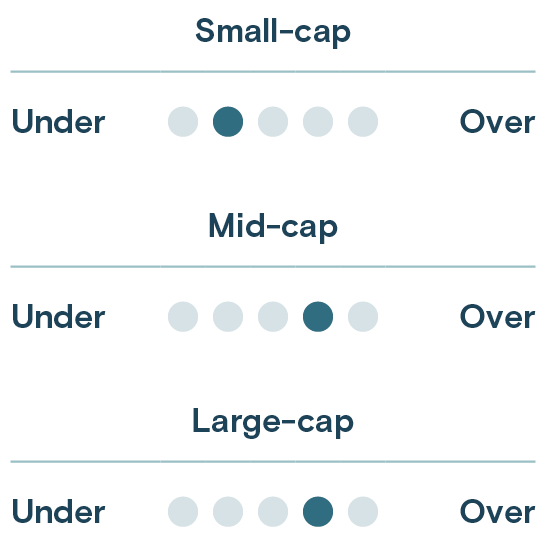
Against this backdrop, we remain moderately overweight U.S. equities, with a preference for large-cap stocks. We are roughly neutral to small- and mid-cap stocks, underweight developed international equities and neutral on emerging markets. While large-cap growth stocks led performance in the third quarter, we expect market leadership to broaden somewhat as economic growth continues.

Interest rates moved higher during the quarter, and we expect the U.S. Federal Reserve (Fed) may implement additional rate increases if inflation remains elevated. We believe rates are likely to stay above the levels experienced over much of the past two decades due to persistent inflation pressures, higher government debt levels and strong demand for capital.

Despite rising yields, we view current Treasury and investment-grade bond yields as attractive for long-term investors. We favor an underweight to short-term Treasuries due to the Fed’s hawkish stance, but maintain a neutral duration exposure as a potential portfolio hedge.



Related content
Capital Markets Perspective

Asset allocation views: Current outlook


Icon of a pie chart with a pie wedge


Fixed income vs. equity

Economic fundamentals remain supportive, with consumer spending, business investment, and a stable labor market helping sustain growth. However, equity markets face increasing risks as valuations remain elevated and market leadership becomes increasingly concentrated in a small group of AI-related companies.

Broader participation has weakened, with small- and mid-cap stocks, value-oriented strategies and equal-weight indexes lagging recent market gains. Potential volatility from U.S. Federal Reserve policy, geopolitical developments, earnings results or the upcoming elections could pressure equities in the near term.

We remain constructive on the long-term outlook and continue to maintain a slight overweight to equities relative to fixed income, balancing opportunity with prudent risk management.

Equities

Equities

Icon of a globe


U.S. vs. Int’l.

We continue to favor U.S. equities over international markets, maintaining an overweight to domestic stocks, a modest underweight to developed international equities and a neutral allocation to emerging markets.

While developed and emerging markets have posted competitive returns at times, we believe the U.S. offers stronger long-term opportunities. Structural headwinds in Europe, including unfavorable demographics, heavier regulation, weaker innovation and ongoing economic challenges support our cautious outlook.

At the same time, we recognize that U.S. market leadership has been fueled by enthusiasm around artificial intelligence, creating the potential for volatility if expectations shift. Our neutral emerging markets position balances growth opportunities with downside risks, resulting in a diversified allocation that continues to favor U.S. equities.


Market cap

We continue to favor large-cap equities over small-cap stocks, maintaining an overweight to large caps and an underweight to public small caps. While small caps have experienced periods of strong performance, we believe higher-quality large companies remain better positioned in the current environment.

Elevated interest rates continue to create challenges for smaller businesses, which generally carry more debt and rely more heavily on short-term financing. In addition, the growth of private markets allows many fast-growing companies to remain private longer, reducing the opportunity set available in public small-cap markets.

As a result, we believe large caps maintain a structural advantage. Our private equity allocation remains focused on smaller companies, where we continue to see attractive long-term growth opportunities.

Fixed income


Duration

We remain neutral on duration as interest rates have moved higher across the Treasury curve amid persistent inflation pressures, resilient economic growth and expectations for additional Fed rate hikes.

While higher inflation expectations, elevated Treasury supply and ongoing investment in AI infrastructure have contributed to higher yields, we believe long-term rates are likely to remain near current levels rather than move sharply higher. At the same time, significantly higher rates could tighten financial conditions and ultimately slow economic growth, which would help limit additional increases in long-term yields.

Within fixed income, we favor a flatter yield curve and maintain an underweight to shorter-term Treasuries given the Fed’s hawkish stance, while retaining balanced duration exposure as a hedge against potential market volatility.


Credit quality1

Credit markets remain supported by a healthy economic outlook, strong demand and generally solid fundamentals, but rising debt issuance tied to AI-related capital spending creates a more cautious backdrop.

While credit spreads widened during the third quarter, they remain historically tight, particularly in investment-grade and high-yield markets.

Attractive yields continue to support our outlook despite recent negative total returns and the potential for additional spread pressure. As a result, we remain moderately overweight credit, with a preference for higher-quality segments that offer compelling income and stronger fundamentals.

We favor securitized credit, investment-grade corporates, investment-grade emerging markets debt and BB-rated high-yield bonds. We also prefer collateralized loan obligations (CLOs) over leveraged loans and remain underweight lower-quality credit, where fundamentals appear weaker.


1 Credit Quality ratings are determined by credit rating agencies Moody’s Investor Services, Inc. or Standard & Poor’s Financial Services, LLC.

The Senior Investment Team is discussing the asset classes, sectors and portfolios they oversee at a macroeconomic level. The views expressed are as of the date given unless otherwise noted and may change as market or other conditions change, and may differ from views expressed by other Thrivent Asset Management, LLC associates. Actual investment decisions made by Thrivent Asset Management, LLC will not necessarily reflect the views expressed. This information should not be considered investment advice or recommendations of any particular security, strategy or product.

Past performance is not necessarily indicative of future results.

Investing involves risks, including the possible loss of principal.