Now leaving ThriventFunds.com


You're about to visit a site that is neither owned nor operated by Thrivent Asset Management.

In the interest of protecting your information, we recommend you review the privacy policies at your destination site.

Financial Professional Site Registration

Complete this form to get full access to the entire financial professional site.

By clicking “Register”, you agree to our privacy and security policies and that you are a financial professional.

Access will be granted immediately, but the registration process may take up to 5 business days to complete.

Thank you for registering

You can now enjoy all financial professional content.

If your download does not start automatically, click here.

An error occurred

Please check back later.

MARKET UPDATE

Actively investing in AI

12/16/2025


Key points

Economic impact

Interest rates are unlikely to rise much further or fall quickly.

Market

Investors may want to consider rotating from cash to Treasuries and/or corporate bonds.


Thrivent Asset Management contributors to this report: Steve Lowe, CFA, chief investment strategist; Peter Karazeris, senior equity research analyst and Jaimin Soni, senior portfolio manager


Key points

AI continues to offer compelling investment opportunities

From software to agentic and physical AI, opportunities will evolve in the years ahead.

The infrastructure investment phase isn’t over 

Consensus capital spending plans may well prove to be conservative.

Over-concentration in AI-related investment remains the largest risk

AI’s potential to raise productivity and revenues is uncertain, but early signs are encouraging.


Artificial intelligence (AI) has rightfully dominated financial headlines as investment in the innovation (and the commitment to embrace it) has been more rapid than many previous technological innovation cycles, such as the introduction of the internet or the adoption of smartphones.

These technological revolutions all follow a similar pattern: a spending cycle over which different industries and companies invest and benefit. We saw this during the build-out of the internet in the late 1990s, the development of cloud-based services, and more recently the growth of the 5G cellular network in the last decade.

With the already strong performance of many large-cap technology companies in recent years, we believe AI will continue to offer compelling investment opportunities. The question is where and when?

The complex transition from investment to return on investment

Most of the money currently spent on infrastructure, research and the deployment of AI products is not for immediate financial payback. AI needs to be viewed as a foundational technology, such as the development of an electrical power grid or the internet, that required short-term costs for potentially exponential gains over the decades ahead.

In the next few years, the return on investment (ROI) in AI may be underwhelming. A recent study from the Massachusetts Institute of Technology found that 95% of the companies they surveyed had not yet seen a measurable return from their AI initiatives. While it may not be complicated to use an AI chatbot at home or at the office for everyday tasks, integrating new technologies into a broader corporate workflow can take time. Some organizations simply are not yet ready for the change from an operational perspective.

Nevertheless, investment in AI has the potential to yield transformative growth across a wide range of companies and other organizations. Management and consulting firm McKinsey & Company recently conducted a global AI survey and found that polled organizations captured value across a variety of functions with the help of AI, leading to sustained revenue growth and greater cost efficiencies. Similarly, Google Cloud surveyed 3,500 executives worldwide and found that 74% reported an ROI from AI in areas that are more difficult to quantify, such as improved decision-making and productivity.

Meanwhile, some of the biggest spenders on AI are creating quantifiable revenue. For example, Microsoft is estimated to grow revenue from its AI services at a very rapid pace, earning nearly $20 billion annually. Additionally, other companies like Google, which stated it’s making billions from AI1, and Meta are reportedly finding their investments in AI are helping improve core products, such as search capabilities and advertising effectiveness.

It is difficult to predict the ROI an average company will achieve from its AI investments, but we expect higher productivity and increased revenue to steadily emerge in the years ahead. As investors, our focus is on identifying individual companies that are likely to be or become leaders across the full AI ecosystem.

The infrastructure investment phase is not over

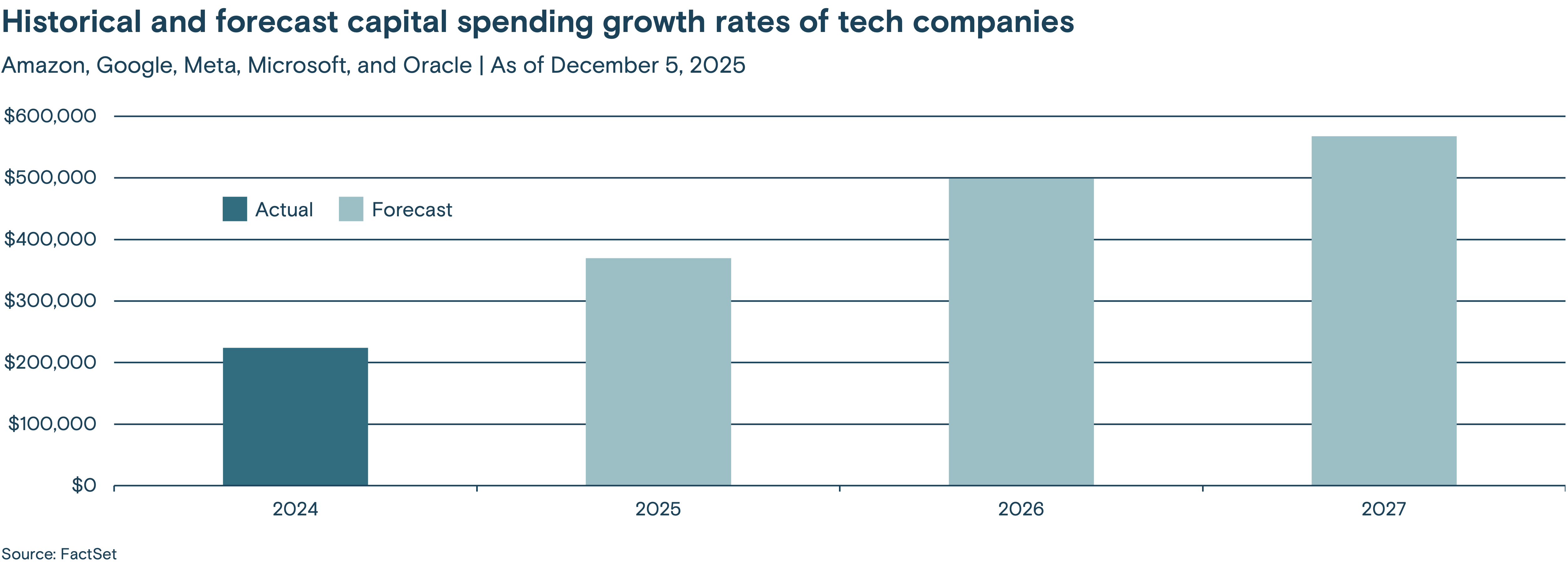
There has been massive investment in developing the infrastructure needed to build the core components of AI, from semiconductors to data centers. Amazon, Meta, Google, Microsoft and Oracle have seen capital spending increases this year—significantly exceeding expectations—and expectations for capital spending in 2026 and 2027 are for continued growth.

The companies that have been most rewarded by these and other companies’ massive investments have primarily been semiconductor manufacturers such as Nvidia, Broadcom and Taiwan Semiconductor. 

Chart illustrating the historical and forecast capital spending growth rates of tech companies

While there has been some concern about the sustainability of this growth, we agree with the market consensus that spending growth will grow substantially next year and is more likely to exceed consensus expectations than to miss them. In our research and interviews with companies across the AI infrastructure supply chain, the consensus capital spending plans may well prove to be conservative.

For example, the Taiwanese electronics manufacturer Foxconn expects requests for the physical racks that hold the servers powering AI to likely double between 2025 and 2026, suggesting investment in servers may also double. Meanwhile, Meta Platforms (commonly known as “Meta”) recently reported it is running up against capacity constraints as it tries to power its existing products while also training new AI models. Also, Microsoft reported that customer demand is driving its plans to double its data center footprint in the next two years.

Beyond semiconductors and servers, there is also a need for greater computer networking and storage space to maximize performance. In the networking space, we believe companies like U.S. computer networking company Arista Networks, U.S. provider of cable and interconnect systems Amphenol and Canadian electronics manufacturing services company Celestica are well positioned to succeed. In the storage sector, which includes memory chips and hard drives, companies like U.S. manufacturer Micron Technology and Korean-based Samsung Group are particularly well positioned for sustained growth. Pricing for memory chips has been particularly robust, in part due to a structural trend in smart devices (from refrigerators to doorbells) as well as from the cyclical demand from AI infrastructure construction.

AI-empowered software has room for enormous growth

As software applications get built on top of AI’s physical infrastructure, a range of services can be deployed, allowing a different set of companies to potentially benefit. The most immediate opportunity lies in infrastructure software. These applications come from companies that work closely with large-scale data centers, often referred to as hyperscalers. Companies like the middle-market U.S. analytics and software company Datadog are very active in this category, while larger companies such as Microsoft and Oracle also offer infrastructure software.

Beyond infrastructure software, the larger market is for specialized application software. While well-known companies like Salesforce, ServiceNow and HubSpot could benefit from greater AI-driven services, the breadth of their offerings and the size of their markets expose them to some risk of disruption from newer AI-driven software companies.

As such, our current preference is for exposure to vertical software companies — companies that target specific industries, particularly those with mission-critical systems. Customers for this kind of software have often built their entire businesses around the application, making them more amenable to AI-driven improvements over switching software providers entirely. Companies like Tyler Software and Guidewire Software are good examples of mid-cap companies that target government or insurance customers.

Finally, social media and consumer service applications, where Meta and Google have strong customer engagement and large revenue bases, have been significant contributors to the companies’ revenue streams. As these companies continue to improve their core products with increasingly sophisticated AI, revenue growth could substantially increase.

Agentic AI is on its way

Our interactions with AI thus far have been primarily limited to a request-response framework. We ask a question to a chatbot and generally get a detailed and relevant answer in response. But, with limited exceptions, there is no action beyond that. We are left to decide what to do with the information the chatbot provides.

Enabling AI not only with better reasoning capabilities but also with the ability to act on our behalf enters the realm of agentic AI, where AI can act as our agent, completing multi-step tasks on its own, including interacting with other software applications. In our view, widespread agentic AI is likely to be the next major step in AI's evolution and will be a significant driver of AI adoption over the next few years.

A simple example of agentic AI would be an AI agent that could book you a vacation. The AI would have to incorporate your preferences in hotels and airlines, budget for the trip and any other preferences provided. In principle, the AI agent could not only optimize all these variables, but also book the plane ticket, reserve the hotel, populate your calendar with the details, email them to your family and know when to turn on and then off your out-of-office email reply.

Agentic AI is expected to become more common next year and will likely favor established companies with large user bases. But we also expect smaller or newer companies that can create a compelling bundle of agentic services with a compelling user interface and robust privacy standards, to potentially gain market share.

Physical AI: The robots are coming

Physical AI, which includes robotics and other mechanical automation, is a nascent sector we believe is ripe for innovation and capable of both disrupting established services and creating new ones.

The more immediate implementation of automation and robotics is likely to be in autonomous vehicles. Waymo, formally known as the Google Self-Driving Car Project, already has taxis on the road, and we expect Tesla will be next to offer “robo” taxis. A number of small and large companies are working to improve the intelligence behind autonomous systems, including, but not limited to, cars.

For example, progress has been made in robots that can play sports and train by watching videos of games. The ability to both learn tasks with AI and then repeat them with robotics opens a world of possibilities, from factory production to dog walking. While such autonomous services will likely take time to prove themselves efficient and safe, the combination of AI and robotics has the potential to increase productivity substantially.

The problem of over-concentration

Considering the range of services AI could improve and the current expectations that it will succeed in delivering that improvement, investors should ask themselves: What would happen to the stock market if AI failed to deliver?

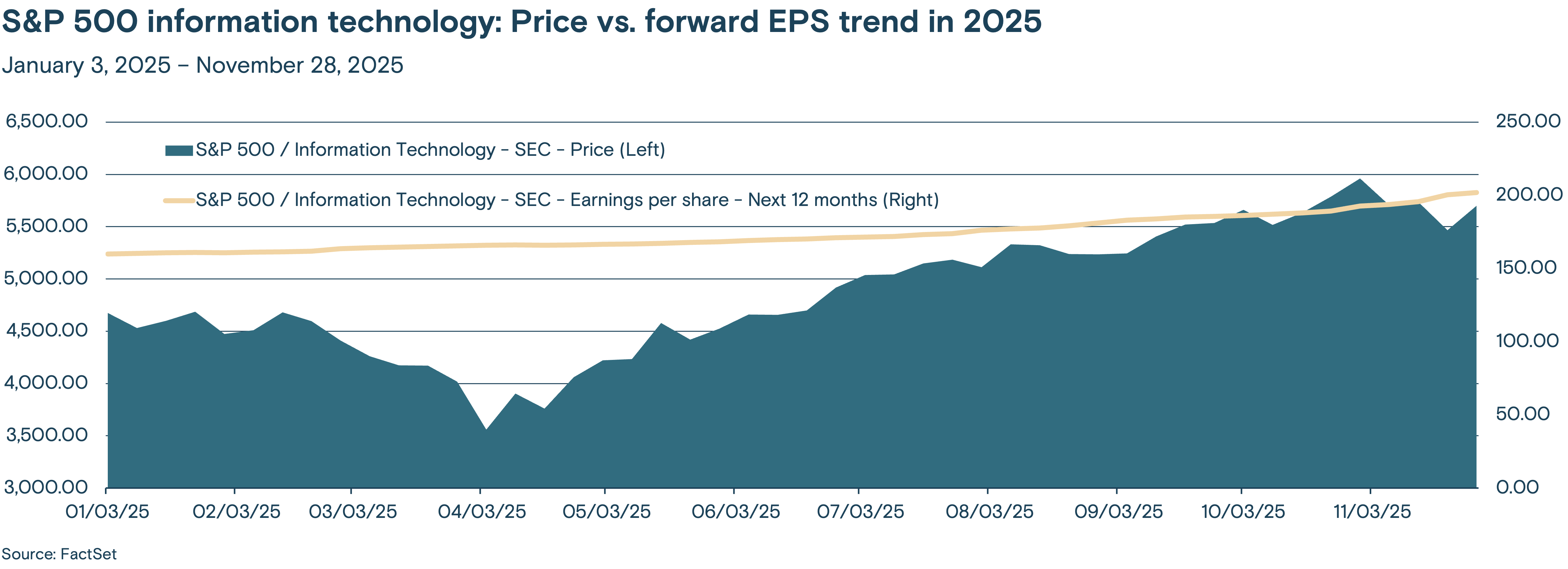
While there has been much discussion about the high valuations of many leading technology companies, the S&P 500® Index’s information technology sector has traded in line with expected earnings, as shown in the figure below, and its current forward price-to-earnings (P/E) ratio is not particularly high. Thus, the key question is whether current earnings expectations will be delivered.

Furthermore, the 10 largest companies in the S&P 500 Index, which are mostly technology or technology-related2, have accounted for nearly 60% of the entire index’s return through early December. As such, investing in a fund that tracks the S&P 500 Index is less an investment in 500 diverse companies than one that allocates half the investment to just 10 companies that share a very similar risk: their ability to justify future earnings expectations.

While we remain positive on the outlook for the U.S. economy and U.S. stocks generally, the current concentration of equity-exposure risk in AI’s ability to deliver expected returns should be a concern for asset allocation decisions in a diversified portfolio.

However, investors who share our view that long-term economic fundamentals drive long-term market returns should take some comfort in our conviction that technology-driven innovation has long been a driver of productivity, boosting growth and revenues. There may have been little return from the first email servers, but few of us could imagine communicating by fax or through the post office today without a significant drop in productivity.


Media contact: Callie Briese, 612-844-7340; callie.briese@thrivent.com

All information and representations herein are as of 12/16/2025, unless otherwise noted.

The views expressed are as of the date given, may change as market or other conditions change, and may differ from views expressed by other Thrivent Asset Management, LLC associates. Actual investment decisions made by Thrivent Asset Management, LLC will not necessarily reflect the views expressed. This information should not be considered investment advice or a recommendation of any particular security, strategy or product. Investment decisions should always be made based on an investor's specific financial needs, objectives, goals, time horizon, and risk tolerance.

This article refers to specific securities which Thrivent Mutual Funds and Thrivent ETFs may own. A complete listing of the holdings for each of the funds is available on thriventfunds.com.

The price/earnings (P/E) ratio is a valuation ratio of a company’s current share price compared to its earnings-per-share, calculation by dividing the market value per share by its trailing 12-month earnings.

The S&P 500® Index is a market-cap weighted index that represents the average performance of a group of 500 large-capitalization stocks.

Any indexes shown are unmanaged and do not reflect the typical costs of investing. Investors cannot invest directly in an index.

Google Cloud Chief Details How Search Giant is Making Billions Monetizing its AI Products. Sept. 10, 2025 https://www.cnbc.com/2025/09/09/google-cloud-chief-details-how-tech-company-is-monetizing-ai.html

Wolfe Research, as of December 10, 2025