Thrivent rings the NYSE Closing Bell®
Thrivent had the opportunity to ring the NYSE Closing Bell® January 5.
01/08/2026
2025 MARKET REVIEW
01/08/2026
Investors may want to consider rotating from cash to Treasuries and/or corporate bonds.
Thrivent Asset Management contributors to this report: John Groton, Jr., CFA, director of administration and materials & energy research; Roger Norberg, director of equity research; and Charles Hofstrom, CFA, investment product manager
Markets ended the year positive after a bumpy start.
Consumer confidence and employment data weakened through the year.
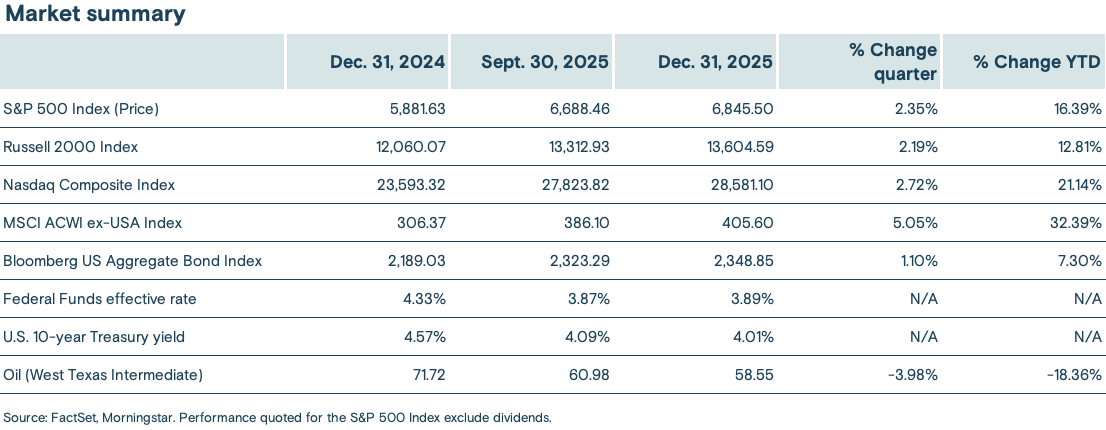
Despite expectations for an average year and a surge in economic policy uncertainty, 2025 delivered strong returns across equity and fixed income markets. The benchmark S&P 500® Index produced its third consecutive year of double-digit gains, rising 16.39%, while the Bloomberg U.S. Aggregate Bond Index, a benchmark for U.S. government, corporate and mortgage-backed securities, rose 7.30%.
The first half of the year was less sanguine, with stocks dropping sharply in April on concerns that the highest tariff rates since the Great Depression in the 1930s could derail economic growth and push inflation higher. But markets rebounded rapidly as tariffs were delayed, canceled or expected to be reduced through negotiations.
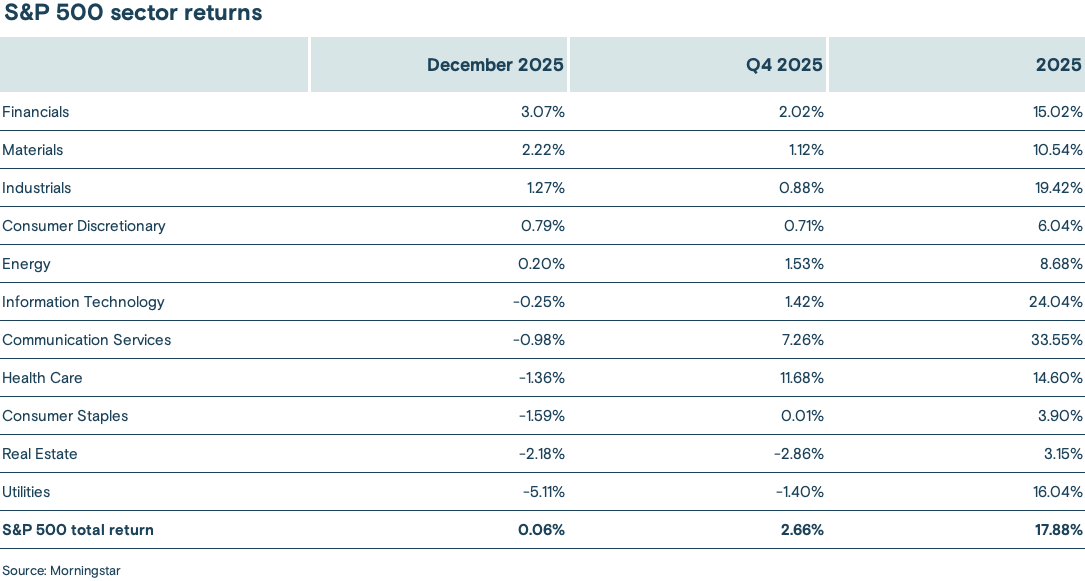
In time, growing expectations for interest-rate cuts by the U.S. Federal Reserve (Fed) and a more stimulative fiscal policy supported an improved economic outlook. But it was consistently strong earnings reports that fueled a sustained rally into year end, driven by strength in the largest technology and technology-related companies, largely due to optimism about the potential of artificial intelligence (AI) to boost corporate profits. The communication services and information technology sectors of the S&P 500 significantly outperformed the broader index, with returns of 33.55% and 24.04%, respectively.
Economic data broadly improved over the course of the year, but consumer confidence waned and consumer spending remained solid despite signs of weakness in middle- to lower-income tiers. Additionally, the labor market showed increased signs of slowing, with reduced hiring and more frequent layoff announcements. While the unemployment rate is still relatively low on an absolute basis, it accelerated in the second half of the year, reaching 4.6% in November, its highest level since the COVID-19 pandemic.
The Fed was in a difficult position in 2025, facing growing concerns about the labor market while inflation remained above its target level. Its decision to cut interest rates multiple times in the second half of the year was supported by its view that goods inflation remained elevated largely because of higher tariffs, and that effect was likely to be temporary.
Bond markets in 2025 were supported by the Fed’s interest rate cuts, a more stable U.S. dollar in the second half of the year and relatively attractive absolute yields. In a welcome development, 2025 showed investors that bonds could again act as a valuable diversifier, rising in both the April and November equity market corrections.
For more on the economy and our outlook for the markets, see: A return to normal?, by Chief Investment Strategist, Steve Lowe, Head of Mixed Asset and Market Strategies, David Spangler and Head of Fixed Income, Kent White.

Stocks were supported by enthusiasm for AI, generally better-than-expected earnings, contained inflation and expectations for lower interest rates. The total return of the S&P 500 Index (including dividends) was 17.88% over the period. The Nasdaq Composite Index rose 21.14% in 2025, supported by strong performance from technology and technology-related companies. The Russell 2000® Index of small-cap stocks rose 12.81% in 2025.
Information technology (up 24.04%) and communication services (up 33.55%) led the S&P 500 Index higher in 2025, but all sectors ended the year with positive returns. Notable laggards included real estate (up 3.15%) and consumer staples (up 3.90%).
The chart below shows the results of the 11 sectors for the past month, quarter and for calendar year 2025.
Consumer confidence deteriorated over the year, but retail sales remained essentially robust. The University of Michigan’s Consumer Sentiment Index fell to 51.0 in November, just above the lowest level (50.0 in June 2022) in the index’s history, which dates to 1978. Additionally, consumer confidence in November, as measured by The Conference Board, declined for the fifth consecutive month. Nevertheless, in aggregate, consumer spending held up through 2025, supported by the higher-income tiers, which accounted for the bulk of total expenditures.
The labor market showed increased signs of slowing in 2025, with reduced hiring and more frequent layoff announcements. The rise in unemployment also was partly due to people re-entering the labor force and actively seeking work but not finding it. The manufacturing sector was particularly weak, with seven straight months of declines, due in part to tariff-related uncertainty. Still, the related jobs data was mixed: the duration of unemployment continued to climb to levels typically seen in a recession, but weekly jobless claims remained relatively steady at a low level.
The yield on 10-year U.S. Treasuries fell in 2025, from 4.57% at the start of the year to 4.17% at year end. Concerns about fiscal policy and the U.S. budget deficit put upward pressure on bond yields over the period, but relatively stable inflation and the Fed’s decision to lower interest rates by 0.75% late in the year supported bond returns. Credit spreads (the yield paid over comparable Treasury bonds) in investment-grade corporate bonds were largely unchanged over the year, near historical lows.
Corporate earnings projections for the S&P 500 Index rose steadily over the year. In the last few quarters, most companies exceeded earnings expectations despite the introduction of tariffs, leading to a steady pace of upward revisions from analysts. The strongest earnings were unusually concentrated, with the top 10 stocks in the S&P 500 Index accounting for an outsized share of total earnings growth.
Despite significant volatility in the first half of the year, the forward 12-month price-earnings ratio (P/E) of the S&P 500 Index was largely unchanged in 2025 at a relatively expensive level, changing from 21.39 at the start of the year to 22.00 at the end of December. A higher P/E means stocks are more expensive relative to their earnings per share. The forward 12-month earnings yield for the S&P 500 Index, which is the inverse of P/E, fell by 0.12% over the year. The 12-month forward earnings yield can help compare equity earnings yields with current bond yields. At December’s end, the 4.55% equity earnings yield remained above the 4.17% yield 10-year U.S. Treasuries offered, but the gap narrowed.
The Nominal Trade-Weighted U.S. Dollar Index fell 7.57% in 2025, its sharpest annual decline in eight years. Narrowing interest-rate differentials (the gap between U.S. and foreign bond yields), policy uncertainty and concerns over the Fed's independence all weighed on the currency in the first half of the year. In the third and fourth quarters, the U.S. dollar was more stable, supported by an improving economic growth outlook and lower expectations for interest-rate cuts.
The price of a barrel of West Texas Intermediate (WTI), a grade of crude oil used as a benchmark in oil pricing, fell 18.36% to $58.55 in 2025, continuing its decline from its peak in mid-2022 when the price exceeded more than $100 a barrel. The decline is largely attributable to oversupply with too much production along with expectations that the demand for oil will slow, creating an abundance of supply. The price of gold surged to a new all-time high, rising above $4,500 an ounce, a gain of more than 70% over the year. A multitude of factors supported gold, including uncertainty around U.S. trade and fiscal policy, demand from the world’s central banks as they sought to diversify their holdings, escalating geopolitical tensions and U.S. interest rate cuts.
The MSCI ACWI ex-USA Index, which tracks stocks across developed and emerging-market economies across the world (excluding the U.S.), rose 32.39% in 2025, significantly outperforming the S&P 500 Index. However, much of the MSCI ACWI’s returns were driven by U.S. dollar weakness that occurred in the first half of the year. Asian markets, excluding China, were particularly strong on the back of enthusiasm for AI. For example, Korean equities rose just over 100% in 2025, in U.S. dollar terms. Emerging-market equities were also notably strong, with Latin America seeing a regional gain above 50%, in U.S. dollar terms.
What can you expect from the economy and the markets in the months ahead? See: A return to normal?, by Chief Investment Strategist, Steve Lowe, Head of Mixed Asset and Market Strategies, David Spangler and Head of Fixed Income, Kent White.
Media contact: Callie Briese, 612-844-7340; callie.briese@thrivent.com
All information and representations herein are as of 01/08/2026, unless otherwise noted.
The views expressed are as of the date given, may change as market or other conditions change, and may differ from views expressed by other Thrivent Asset Management, LLC associates. Actual investment decisions made by Thrivent Asset Management, LLC will not necessarily reflect the views expressed. This information should not be considered investment advice or a recommendation of any particular security, strategy or product. Investment decisions should always be made based on an investor's specific financial needs, objectives, goals, time horizon, and risk tolerance.
Any indexes shown are unmanaged and do not reflect the typical costs of investing. Investors cannot invest directly in an index.
The forward PE ratio uses the forecasted earnings per share of the company over the next 12 months for calculating the price-earnings ratio. It is calculated by dividing the price per share by forecasted earnings per share over the next 12 months.
Earnings yield is the 12-month earnings divided by the share price. Earnings yield is the inverse of the P/E ratio. Earnings yield is one indication of value; a low ratio may indicate an overvalued stock, or a high value may indicate an undervalued stock.
The S&P 500® Index is a market-cap weighted index that represents the average performance of a group of 500 large-capitalization stocks.
The Russell 2000® Index is an unmanaged index considered representative of small-cap stocks.
The Nasdaq Composite Index is a stock market index that includes almost all stocks listed on the Nasdaq stock exchange. The Nasdaq – National Association of Securities Dealers Automated Quotations – is an electronic stock exchange with more than 3,300 company listings.
The MSCI ACWI ex-USA Index is an unmanaged index considered representative of large- and mid-cap stocks across developed and emerging markets, excluding the U.S.
The Bloomberg U.S. Aggregate Bond Index is an unmanaged index considered representative of the U.S. investment-grade, fixed-rate bond market.
The Nominal Trade-weighted U.S. Dollar Index measures the value of the U.S. dollar based on its competitiveness versus trading partners.
The Consumer Confidence Index (CCI) is a survey administered by the Conference Board. The CCI measures what consumers are feeling about their expected financial situation, whether that's optimistic or pessimistic.
The University of Michigan Consumer Sentiment Index is a consumer confidence index published monthly by the University of Michigan.
Past performance is not necessarily indicative of future results.