![New leadership of the Federal Reserve [PODCAST]](/content/dam/thrivent/fp/fp-insights/advisors-market360-podcast/advisors-market360-podcast-16x9-branding-insights-card.jpg/_jcr_content/renditions/cq5dam.web.1280.1280.jpeg)
New leadership of the Federal Reserve [PODCAST]
A new Fed Chair has been approved. Will the economy also approve?
05/26/2026
MARKET UPDATE
05/26/2026
Investors may want to consider rotating from cash to Treasuries and/or corporate bonds.
Thrivent Asset Management contributors to this report: Steve Lowe, CFA, chief investment strategist, and Kent White, CFA, head of fixed income
He comes with impressive academic credentials, served as a Fed Governor during the Global Financial Crisis and has notable private-sector experience.
Warsh may change the Fed’s preferred measure of inflation and is likely to change how the Fed communicates publicly.
Despite concerns, we believe Warsh will be a champion for Fed independence, even if that means raising interest rates in the face of higher inflation.
On May 13, 2026, Kevin Warsh was confirmed as only the 11th Chairman of the U.S. Federal Reserve (Fed) since World War II. As chair Warsh will set the tone for everything from monetary policy to the Fed’s communication style. While we expect, in the broadest terms, key roles of the Fed and the Federal Open Market Committee (FOMC), which is responsible for setting interest rates, to remain fundamentally unchanged, every new Chair brings changes, and Warsh may bring more than usual.
Kevin Warsh’s first role in the limelight was as an extra alongside Jack Nicholson and Meryl Streep in the 1987 film Ironweed. The lights will be much more intense for him as chairman of the Fed. Warsh is well prepared with economic and policy credentials that are exemplary. He attended Stanford University, where he received a Bachelor of Arts in public policy in 1992 and met his wife, Jane Lauder (heiress to the Estée Lauder cosmetics business). He then attended Harvard Law, graduating cum laude in 1995.
After law school, he joined Morgan Stanley as an associate specializing in mergers and acquisitions, where he remained until 2002 when President George W. Bush named him a special assistant for economic policy and the executive secretary of the National Economic Council, which coordinates domestic and international economic policy for the President. Then, in 2006, President Bush nominated him to serve on the Fed’s Board of Governors (which he will now chair), becoming the youngest Fed Governor in the institution’s history1. He served through the Global Financial Crisis (GFC), one of the most difficult periods for the Fed, and was its primary liaison to the financial markets throughout his tenure.
Warsh’s academic, government and private-sector experience suggest he will provide a steady hand in setting monetary policy and be well qualified to help manage the economy during periods of economic crisis.
The Fed has a dual mandate to maintain price stability and maximum employment. While every Fed Chair struggles to balance these generally competing goals, Warsh’s history suggests he is more “hawkish”—meaning he is thought to prioritize containing inflation over maximizing employment. Warsh has repeatedly used the phrase “inflation is a choice” to suggest inflation is preventable and the Fed should be held accountable for allowing it to rise after the COVID-19 pandemic. Similarly, Warsh has long been an opponent of “quantitative easing”—using the Fed’s balance sheet to buy assets, thereby injecting money into the economy to stimulate growth.
Warsh has also been vocal about his optimism that artificial intelligence (AI) could significantly boost economic productivity. More evidence is needed, but if Warsh is correct, it could allow the economy to generate a higher gross domestic product (GDP) without higher levels of employment or inflation. Warsh wrote in a November 2025 op-ed for the Wall Street Journal that AI “will be a significant disinflationary force,” allowing prices to fall as production costs fall. Such an environment could justify lower interest rates insofar as inflation is contained (and possibly slowing) while employment remains stable.
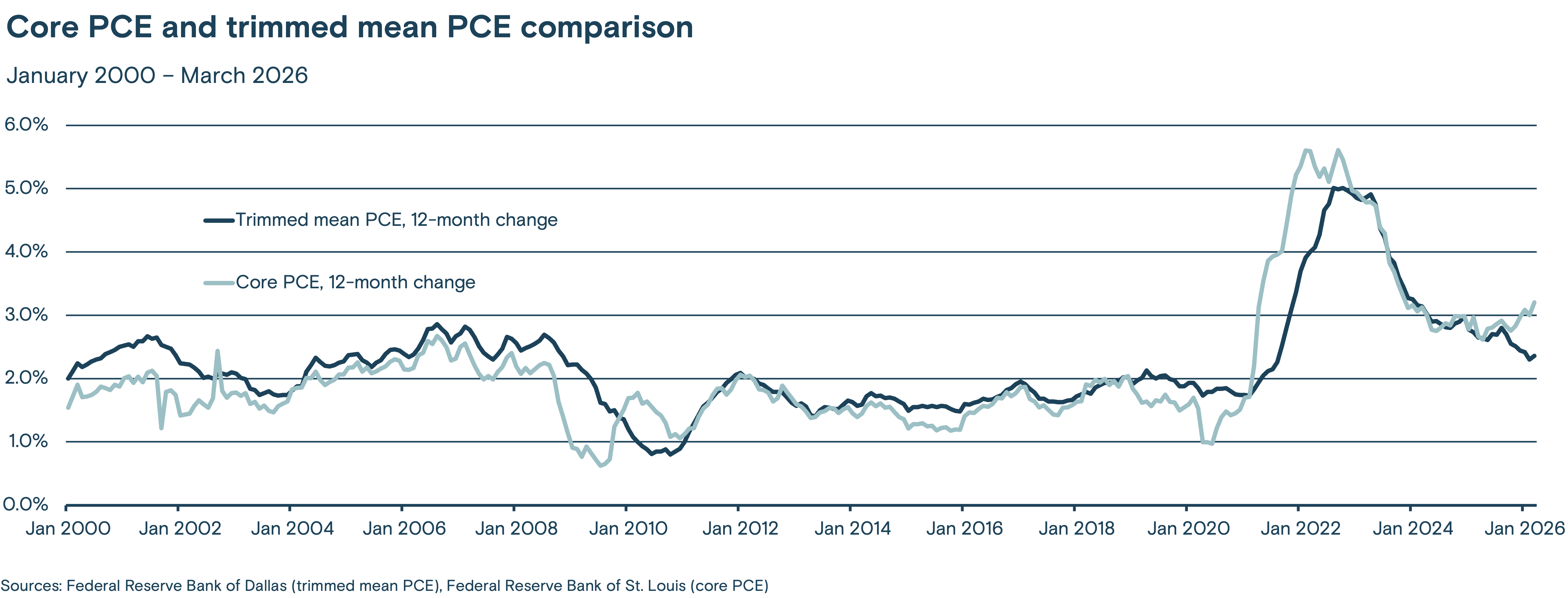
The Fed’s target of containing inflation at 2% over the long term likely will not change, but how inflation is measured may. The Core Personal Consumption Expenditures (PCE) Price Index has been the preferred measure of inflation for decades, but Warsh favors a different measure. Commonly known as “trimmed mean” inflation, the index is calculated by the Federal Reserve Bank of Dallas and excludes components of the Core PCE Price Index that exhibit more extreme price changes over the measured period.
According to a 2019 Fed study, “the trimmed mean PCE Price Index is able to smooth across large idiosyncratic episodes better than the index excluding food and energy.”2 While the point is debated, trimmed-mean PCE has typically tracked Core PCE and even the widely monitored Consumer Price Index (CPI) over the longer term, but with less volatility, as can be seen in the figure below3.
While the trimmed-mean index has typically floated in the middle of the conventional inflation indices, it has recently dipped below them. To the extent the trimmed mean index becomes the Fed's preferred measure of inflation, it is not only approaching the Fed’s long-term 2% target but has also trended lower over the past three years. While it may sound like a case of moving the goalposts, elevating the importance of this measure could provide the Fed with a rationale for easier monetary policy.
Warsh has been consistent in his desire to reduce the amount of Fed communications. In contrast to Chairman Jerome Powell’s leadership—who Warsh just succeeded--in which statements about the Fed’s thinking on economic conditions were notably more frequent, Warsh may reduce the number of official press conferences and encourage less public speaking by Fed Governors. While this could sound like a retreat into opacity, there is a contingent of market participants who would welcome such a change.
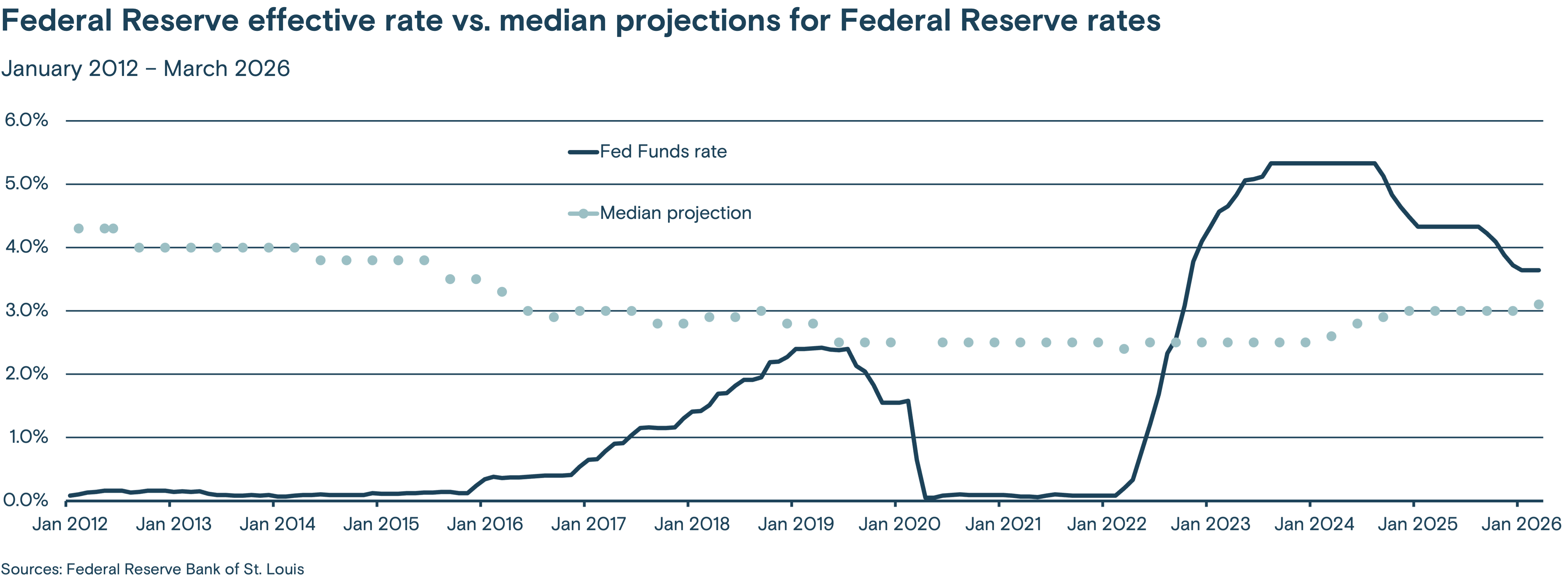
One reason for this support is that various Fed speakers sometimes expressed differing views, increasing uncertainty. But many have also regarded the Fed’s attempt to provide guidance on its economic views as unhelpful because it was often wrong. The figure below illustrates the stability of the Fed’s projections of its benchmark interest rate against the volatility of the actual rate. Simply put, the figure shows the Fed’s own projections too often failed to anticipate the need to lower or raise interest rates.
A reduction in Fed communication could increase market volatility, particularly on days when the FOMC announces its interest rate intentions. But to the extent that markets already build a consensus about expected rate changes, and that consensus evolves (sometime creating market volatility) with each economic data release, any additional volatility resulting from diminished transparency could be modest.
Kevin Warsh’s appointment as Chairman of the Fed has been clouded by public disagreements between President Donald Trump and the outgoing Chairman, Jerome Powell. The charges the U.S. Department of Justice brought against Powell have been dropped, but Powell’s term as a Fed Governor does not end until 2028 and he has indicated he could remain on the board until he is comfortable that the charges will not resurface. While the prior Chairman remaining as a Fed Governor is highly unusual—something not seen in almost 80 years—it could provide some brief continuity in Fed policy, and Powell has been clear he will defer leadership to Warsh.
Additionally, President Trump’s aggressive advocacy for lower interest rates during Powell’s term raised questions about the President’s commitment to an independent Fed and whether his decision to nominate Warsh implied he would provide some deference to the President in matters of monetary policy.
Financial markets have benefited from Fed independence for decades, and the most famous attempt by a President to interfere contributed to rampant inflation and a recession, resulting in the infamous stagflation of the 1970s. Then President Richard Nixon quipped about then Fed Chairman Arthur Burns, “I respect his independence. However, I hope that independently he will conclude that my views are the ones that should be followed.” While many factors, including OPEC's quadrupling of oil prices in 1973, fueled stagflation, Arthur Burns’ interest-rate policy is widely regarded as a failure, and his legacy is tarnished by his presumed deference to Nixon.
| Term | Appointee | President(s) |
|---|---|---|
| Term | Appointee | President(s) |
| Feb. 1, 1936 – Jan. 31, 1948 | Marriner S. Eccles | Franklin Roosevelt, Harry Truman |
| Apr. 15, 1948 – Mar. 31, 1951 | Thomas B. McCabe | Harry Truman |
| Apr. 2, 1951 – Jan. 31, 1970 | William M. Martin Jr. | Harry Truman, Dwight Eisenhower, John Kennedy, Lyndon Johnson, Richard Nixon |
| Feb. 1, 1970 – Jan. 31, 1978 | Arthur F. Burns | Richard Nixon, Gerald Ford, Jimmy Carter |
| Mar. 8, 1978 – Aug. 6, 1979 | G. William Miller | Jimmy Carter |
| Aug. 6, 1979 – Aug. 11, 1987 | Paul A. Volcker | Jimmy Carter, Ronald Reagan |
| Aug. 11, 1987 – Jan. 31, 2006 | Alan Greenspan | Ronald Reagan, George H.W. Bush, Bill Clinton, George W. Bush |
| Feb. 1, 2006 – Jan. 31, 2014 | Ben S. Bernanke | George W. Bush, Barack Obama |
| Feb. 3, 2014 – Feb. 3, 2018 | Janet L. Yellen | Barack Obama, Donald Trump |
| Feb. 5, 2018 – May 13, 2026 | Jerome H. Powell | Donald Trump, Joe Biden, Donald Trump (term 2) |
| May 13, 2026 – Present | Kevin M. Warsh | Donald Trump (term 2) |
Sources: Federal Reserve and White House
For now, the market appears to have reached a consensus that despite Warsh’s credentials as an inflation hawk, he could lean dovish over time while remaining committed to Fed independence. But this does not mean markets are not watching closely, and it will likely take some time for confidence in Warsh’s commitment to be confirmed.
The current conflict in the Middle East has elevated oil prices, putting upward pressure on inflation. As oil reserves in both the public and private sectors already have been meaningfully drawn down, sustained conflict could have an increasingly negative impact on oil prices and inflation.
Meanwhile, at last month’s FOMC meeting, there was the greatest number of dissents from the committee’s published statement since 1992. Three regional Fed presidents indicated they did not support the Fed signaling the next change in interest rates is still likely to be an additional cut. If inflation continues to climb, Warsh may have an increasingly difficult time resisting these calls for a more hawkish policy and may even signal that higher interest rates are increasingly likely. Such a statement could raise the ire of the Executive branch that has advocated for rate cuts, and Warsh’s commitment to Fed independence could face an early test.
Specifically, any clear indication that containing inflation is a priority would likely boost the market’s confidence in Warsh’s leadership, providing immediate support to the Treasury market, while the opposite could significantly damage the market’s faith in Warsh, pushing bond yields higher.
The majority of FOMC members had generally viewed the current level of interest rates as restrictive, leaving room to lower them as needed. But the conflict in the Middle East has created significant uncertainty about its effects on the economy and inflation. Even the U.S. Treasury Secretary, Scott Bessent, recently softened the administration’s push for lower interest rates, saying on April 22, “I believe rates should be cut,” but adding that he understands if FOMC members “want to wait for some clarity.”4
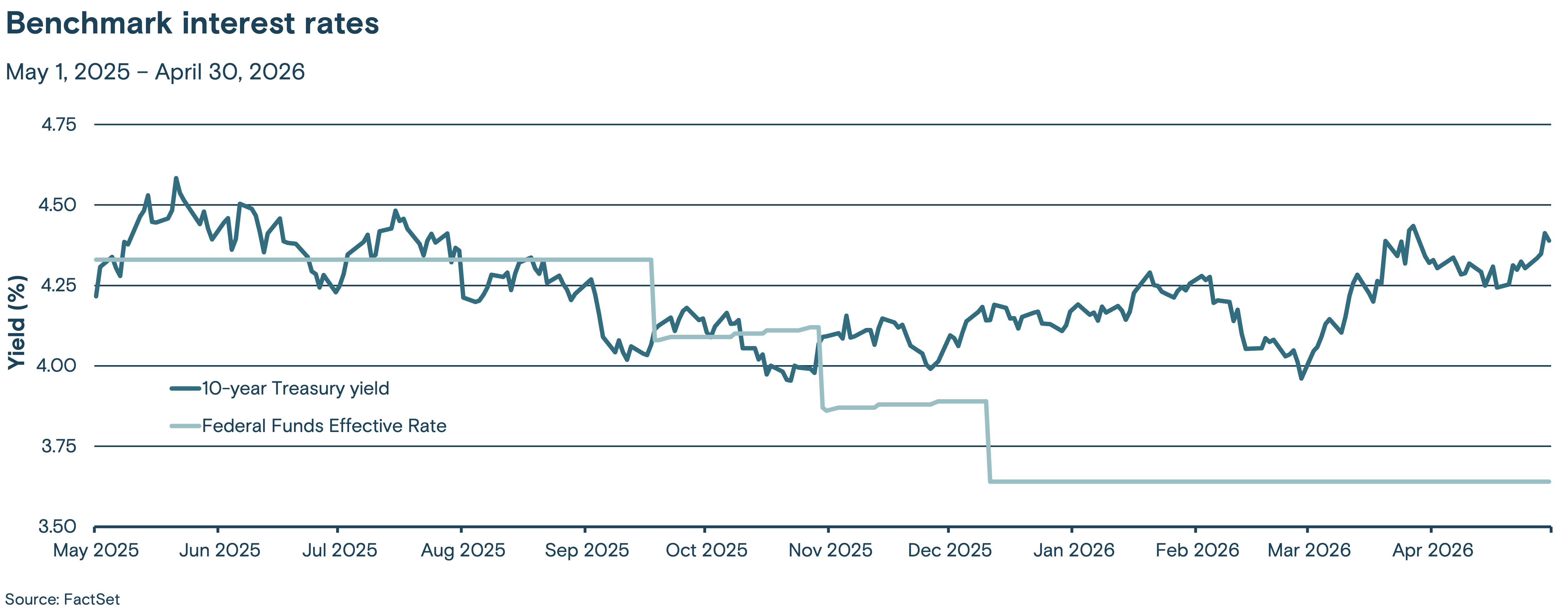
Clarity may not be coming soon. West Texas Intermediate (a grade of crude oil used as a benchmark in oil pricing) has been volatile around $100 a barrel for almost two months, and bond yields have risen across the world’s major economies as concerns about rising inflation take hold. Meanwhile, the market has priced out any rate cuts for the remainder of 2026, and it is increasingly likely the Fed could raise interest rates before cutting them again.
While the duration of the conflict in the Middle East is difficult to estimate, we take comfort in the knowledge that Warsh is highly qualified, understands financial markets and takes the Fed’s responsibility to contain inflation seriously. In our view, Warsh wants to succeed in his role as Chairman of the Fed. He respects the institution to the point of publicly admonishing it for choosing (his word) to allow inflation to rise. In periods of high uncertainty, having a leader who helped the Fed manage its response to the GFC could provide an anchor for global central banks and be just what financial markets need to successfully navigate the current environment.
Media contact: Callie Briese, 612-844-7340; callie.briese@thrivent.com
All information and representations herein are as of 05/26/2026, unless otherwise noted.
The views expressed are as of the date given, may change as market or other conditions change, and may differ from views expressed by other Thrivent Asset Management, LLC associates. Actual investment decisions made by Thrivent Asset Management, LLC will not necessarily reflect the views expressed. This information should not be considered investment advice or a recommendation of any particular security, strategy or product. Investment decisions should always be made based on an investor's specific financial needs, objectives, goals, time horizon, and risk tolerance.
The Core Personal Consumption Expenditures (PCE) Price Index, also known as consumer spending, is a measure of the spending on goods and services, excluding food and energy prices, by people of the U.S.
The Consumer Price Index measures the monthly change in prices paid by U.S. consumers for a basket of goods and services.
The FRB Dallas Trimmed-mean PCE is an alternative measure of core inflation. It calculates inflation by looking at the price changes across all components of Personal Consumption Expenditures (PCE), sorting them from lowest to highest, and discarding the most extreme outliers at both ends before finding the weighted average of the remaining items.
The FRB Cleveland Median 12-month PCE is an underlying inflation measure calculated by ranking the price changes of all personal consumption expenditure (PCE) components from the Bureau of Economic Analysis and taking the 12-month change of the category in the exact 50th percentile.
The Nominal Trade-weighted U.S. Dollar Index measures the value of the U.S. dollar based on its competitiveness versus trading partners.
The Federal Funds effective rate is the interest rate at which depository institutions (mainly banks) lend reserve balances to other depository institutions overnight on an uncollateralized basis. In simpler terms, it's the rate banks charge each other for short-term loans to meet their reserve requirements.
Any indexes shown are unmanaged and do not reflect the typical costs of investing. Investors cannot invest directly in an index.
Past performance is not necessarily indicative of future results.
1 Meet Kevin Warsh, the 56-year-old Stanford and Harvard Law grad who was just named the next Fed chair. May 13, 2026. Yahoo Finance. (May 21, 2026).
2 Comparing two measures of core inflation: PCE excluding Food & energy vs. the Trimmed Mean PCE Index. August 2, 2019. Board of Governors of the Federal Reserve System. (May 21, 2026).
3 Core confusion: Making sense of multiple inflation metrics. May 5, 2026. Federal Reserve Bank of Richmond. (May 21, 2026).
4 Exclusive/Bessent: US should ‘wait and see’ before lowering interest rates. April 13, 2026. SEMAFOR. (May 21, 2026).