Now leaving ThriventFunds.com


You're about to visit a site that is neither owned nor operated by Thrivent Asset Management.

In the interest of protecting your information, we recommend you review the privacy policies at your destination site.

Financial Professional Site Registration

Complete this form to get full access to the entire financial professional site.

By clicking “Register”, you agree to our privacy and security policies and that you are a financial professional.

Access will be granted immediately, but the registration process may take up to 5 business days to complete.

Thank you for registering

You can now enjoy all financial professional content.

If your download does not start automatically, click here.

An error occurred

Please check back later.

OUR VIEW

A look ahead: Third quarter 2026 outlook

10/12/2021

07/10/2026

10/12/2021

A look ahead: Q3 2026 outlook

U.S. economic data is generally outperforming expectations, resulting in solid economic growth.

Our base case is U.S. economic growth will remain solid, but the ability of AI leaders to monetize their investments and increase earnings enough to justify their rich valuations remains uncertain. In the long run, we think AI will not just provide ongoing productivity gains but will ultimately prove revolutionary. Nevertheless, expectations are high, and bouts of uncertainty will lead to volatility.

Inflation remains an ongoing concern. It has been above the U.S. Federal Reserve’s (Fed) 2% target since 2021, raising concerns that inflation expectations could rise, risking a self-fulfilling prophecy. While oil prices have fallen recently, we expect continued uncertainty about the conflict in the Middle East, solid consumer spending and strong demand for AI infrastructure, such as semiconductors and computing equipment, to keep core inflation above the Fed’s 2% target.

We believe the Fed is likely to raise rates this year, possibly as soon as the September meeting, given the recent rise in core inflation.

Given our broadly constructive outlook, we continue to recommend maintaining exposure to U.S. equities, favoring an overweight to large-cap stocks and a moderate overweight to mid-cap stocks as we expect continued strength to broaden. In fixed income, we expect modest flattening of the yield curve, favoring longer-dated Treasury securities and higher-quality corporate bonds. Investment-grade corporate bond spreads (the yield paid over comparable Treasuries) are relatively narrow, but as their absolute yields remain attractive, we expect continued demand.



Related content
Capital Markets Perspective

Asset allocation views: Current outlook


Icon of a pie chart with a pie wedge


Fixed income vs. equity

After a weak start to the year, the S&P 500® Index gained nearly 15% in Q2, driven first by easing Middle East tensions and later by AI enthusiasm, solid earnings and improving economic conditions. Market gains broadened beyond mega-cap technology stocks, with the equal-weight S&P 500 reaching all-time highs.

Manufacturing, production, retail sales and jobs data continue to show strength. While concerns over inflation, housing and weak consumer sentiment surveys persist, it was notable that consumer spending data posted the strongest year-over-year gain in over a decade.

After such a strong and persistent surge in Q2, the market may enter a healthy consolidation phase. We maintain a modest overweight to equities, as improving earnings and market breadth support a constructive stance.

Equities

Equities

Icon of a globe


U.S. vs. Int’l.

U.S. stocks outperformed international in Q2 and over the trailing 12-month period, but lagged vs. emerging markets, which were boosted by high returns from several countries with high concentration in AI-related shares.

We maintain an overweight to U.S. equities, a modest underweight to developed international (especially the Eurozone), and a neutral stance on emerging markets. We may look to opportunistically trim Eurozone exposure, due to possible challenges this region faces in demographics, regulatory regime and innovation and investment.

The neutral view on emerging markets reflects a balance between continued AI-related growth prospects and the risk of a sharp reversal, given the market’s concentration in a relatively small number of companies and countries.


Market cap

Small-cap stocks outperformed large-cap by 6% in Q2 and 19% over the past year. Such a wide performance gap in favor of small-caps reflects a rising investor risk appetite and gains among lower-quality, lower-profitability companies.

Historically, periods of lower-quality outperformance are followed by a return to leadership of higher-quality companies with strong earnings and balance sheets, which are heavily represented among large-cap stocks.

We continue to believe that the fact that smaller, fast-growing companies now remain privately held for longer than in previous eras may create a structural advantage for large-cap stocks.

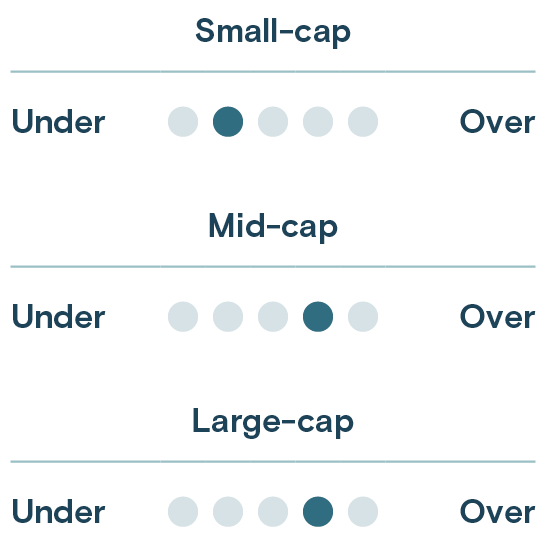
We are underweight small-caps, modestly overweight mid-cap and overweight large-caps.

Fixed income


Duration

Treasury yields increased across the curve during Q2, led by short-term rates as investors priced in a more hawkish Federal Reserve.

The Fed’s preferred inflation measure, Core Personal Consumption Expenditures, has stubbornly remained above its 2% target since 2021. New Fed Chair, Kevin Warsh, has emphasized a strong commitment to controlling inflation, and the market now expects one rate hike in 2026.

We are positioned for a slightly flatter Treasury curve, maintaining an overweight to longer-duration bonds as a hedge against equity market downturns while remaining underweight short-duration bonds due to expectations for a continued hawkish Fed.


Credit quality1

Credit spreads narrowed in Q2 as geopolitical concerns eased and investor demand for credit remained robust. While credit spreads are tight vs. historical averages, the absolute levels of yield are attractive to some investors and corporate fundamentals are broadly supportive.

The increased issuance of debt from technology companies in order to make AI-related expenditures could put upward pressure on spreads.

We remain moderately overweight to credit, with a tilt to investment-grade corporates, securitized bonds (especially collateralized loan obligations) and investment-grade emerging market debt. We are underweight lower-quality fixed income segments, such as high yield and leveraged loans, due to their weaker fundamentals and sensitivity to higher interest rates.


1 Credit Quality ratings are determined by credit rating agencies Moody’s Investor Services, Inc. or Standard & Poor’s Financial Services, LLC.

The Senior Investment Team is discussing the asset classes, sectors and portfolios they oversee at a macroeconomic level. The views expressed are as of the date given unless otherwise noted and may change as market or other conditions change, and may differ from views expressed by other Thrivent Asset Management, LLC associates. Actual investment decisions made by Thrivent Asset Management, LLC will not necessarily reflect the views expressed. This information should not be considered investment advice or recommendations of any particular security, strategy or product.

Past performance is not necessarily indicative of future results.

Investing involves risks, including the possible loss of principal.