Diversify your portfolio
Exchange-traded funds can offer compelling benefits in terms of diversification. From an asset allocation standpoint, ETFs can complement and augment the other building blocks of an investor’s portfolio—whether that’s cash, individual securities (equities or fixed income) or alternative investments (e.g. private equity, hedge funds, real estate, etc.).
Meanwhile, ETFs allow for diversification because they offer investors access to such a wide range of stocks and bonds. There are ETFs that seek to track broad market indices (such as the Nasdaq-100®), strategies that fulfill parts of a portfolio such as value, growth or income as well as funds that focus on specific countries or sectors. Financial advisors can buy a mix of ETFs designed to help meet their client’s unique needs and objectives.
Investors can also choose from passive and active ETFs. Passive ETFs buy and hold a basket of securities, which are typically representative of an index, sector or country. These types of ETFs often sport ultra-low fees, as the fund provider doesn’t need to maintain as large of teams of analysts and portfolio managers.
While passive funds still dominate the ETF space, investors now have increasing access to actively managed ETFs. These function in the same way as passive ETFs but have professional managers at the helm buying and selling in a bid to outperform an index or other benchmark. Active ETFs do tend to come with higher fees, but they also have the potential to outperform their benchmarks.
Learn more about Thrivent Asset Management’s growing suite of actively managed ETFs, featuring both equity and fixed income-focused strategies.
Low cost and easy access
Two features that have made ETFs so popular are their low fees and their ease of access. Take cost, for starters. Compared to mutual funds, exchange-traded funds have lower management expense ratios (MERs). ETF fees at Thrivent Asset Management range from 0.20%-0.65%, depending on the strategy.
Anyone with a brokerage account (whether it’s self-directed or through a financial advisor) can buy and sell ETFs. Indeed, with online trading, this can literally be done with the click of a few buttons.
Exchange-traded funds are accessible in another way as well—there’s no minimum purchase. This makes them ideal for clients who are just starting their careers or are looking to explore new funds. Mutual funds, on the other hand, typically require a minimum investment.
Intra-day trading
Another advantage of ETFs is that you can buy and sell them throughout the trading day. While we don’t recommend attempting to time the market, investors would have the ability to respond to market changes as they happen. Intra-day trading is also crucial because it allows investors to buy and sell a holding instantaneously. This allows you, for instance, to quickly raise funds if you spot another investment opportunity.
Tax efficiency
Returns matter for investors, but what really matters are after-tax returns. Fortunately, the way ETFs are designed can help minimize the taxes paid by investors holding the ETF. At a high level, ETFs can engage in “in kind” transactions for their underlying securities, which avoid the realization of capital gains. This leads to lower capital gains taxes payable for those who hold an ETF. While investors will still realize capital gains for the increase in their purchase price versus their sale price, trading activity within the ETF likely won’t have any tax implications.
Price efficiency
Price matters. You want to feel confident that you won’t pay more for a share than it is currently worth, or sell a share for less than its underlying value.
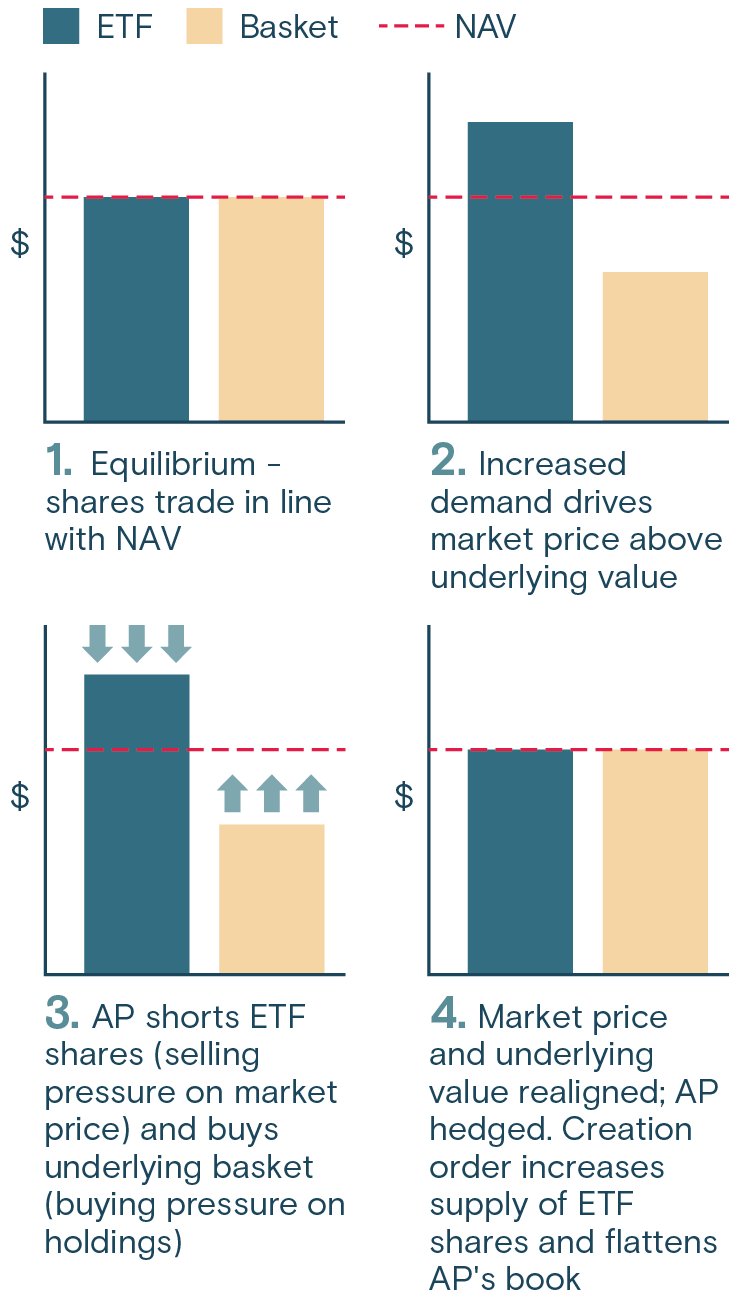
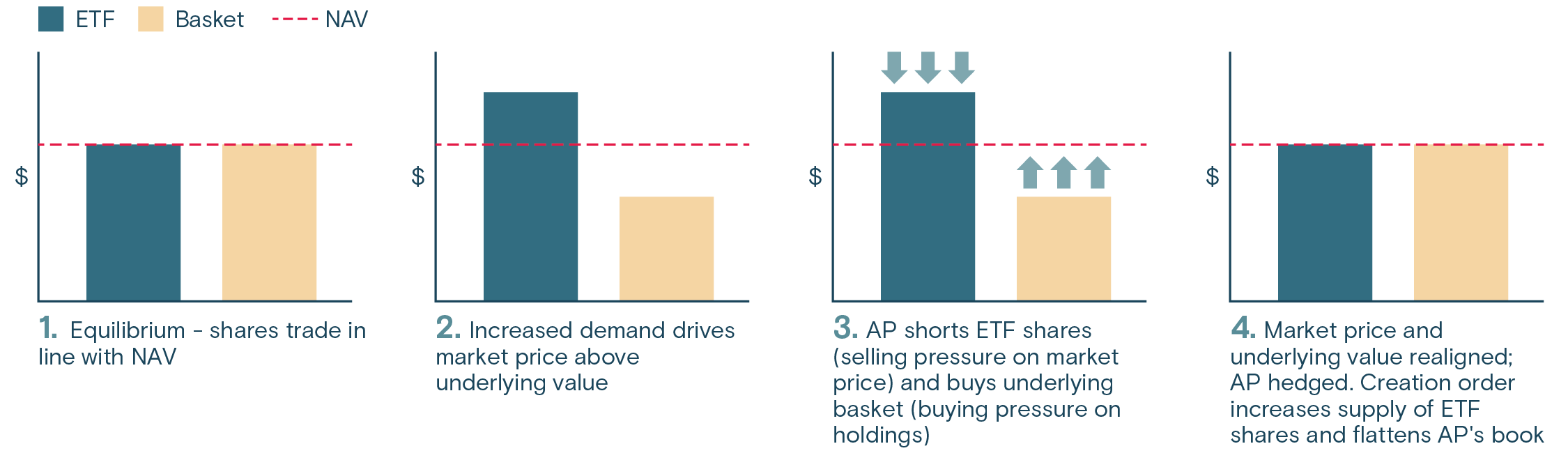
One of the strengths of ETFs is that their structure includes built-in mechanisms designed to help promote price efficiency for investors. These mechanisms are designed to keep the ETF close to its net asset value (NAV*), preventing funds from trading at steep premiums or discounts.
First, each ETF has one or more designated authorized participants (APs). These are typically brokerage firms or other trading companies that act as the gatekeepers of an ETF’s share supply. Authorized participants may deal both in a given ETF, as well as that ETF’s underlying assets—creating and redeeming units of a fund in large blocks called creation units. Only authorized participants interact directly with the fund to create and redeem ETF shares.
If the market price of an ETF is trading at a discount to its NAV, an authorized participant can buy ETF shares on the exchange and redeem them with the fund’s issuer, in exchange for the underlying securities. On the flip side, if an ETF is trading at a premium to its NAV, an authorized participant can profit by doing the reverse: buying the underlying securities and delivering them to the fund provider in exchange for newly created ETF shares, which can then be sold in the market. Supply is elastic and can be adjusted to meet demand. This kind of arbitrage is profitable for the authorized participant and brings the market price of a fund in line with its value.



![2026 Q4 Market Outlook [PODCAST]](/content/dam/thrivent/fp/fp-insights/advisors-market360-podcast/advisors-market360-podcast-16x9-branding-insights-card.jpg/_jcr_content/renditions/cq5dam.web.1280.1280.jpeg)
![Q4 2026 Market Outlook [VIDEO]](/content/dam/thrivent/fp/fp-insights/market-updates/q4-2026-market-outlook/q4-2026-market-outlook-1920x1080.png/_jcr_content/renditions/cq5dam.web.1280.1280.jpeg)