![2026 Second Quarter Market Outlook [PODCAST]](/content/dam/thrivent/fp/fp-insights/advisors-market360-podcast/advisors-market360-podcast-16x9-branding-insights-card.jpg/_jcr_content/renditions/cq5dam.web.1280.1280.jpeg)
2026 Second Quarter Market Outlook [PODCAST]
What does a potential energy shock mean for inflation, growth, and the Fed’s next move?
03/31/2026
1st QUARTER 2026 MARKET REVIEW
04/08/2026
Investors may want to consider rotating from cash to Treasuries and/or corporate bonds.
Thrivent Asset Management contributors to this report: John Groton, Jr., CFA, director of administration and materials & energy research; Kent White, CFA, head of fixed income mutual funds; and Charles Hofstrom, CFA, senior product specialist
Rising tensions in the Middle East drove volatility across equities, bonds, currencies and commodities.
Value, cyclical and small‑cap stocks increased over large‑cap technology.
Treasury yields rose across the curve and corporate credit spreads widened modestly amid heavy issuance from large‑cap and AI‑related companies.
The economy: The U.S. economy’s underlying fundamentals showed broad strength entering 2026 and gained support over the quarter from changes to tax policy in 2025, lower interest rates and increased deregulation. However, employment data was volatile over the period, inflation ticked higher and rising geopolitical tensions raised concerns about the outlook for inflation, interest rates, employment and economic growth.
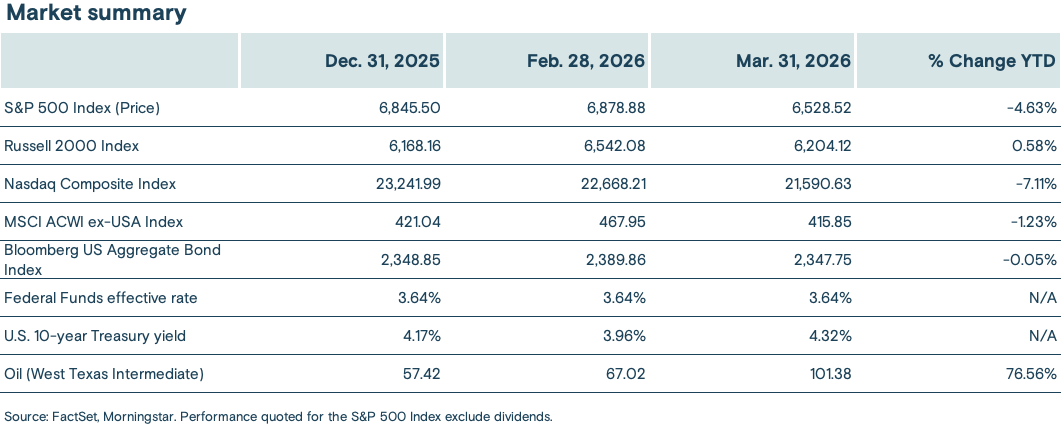
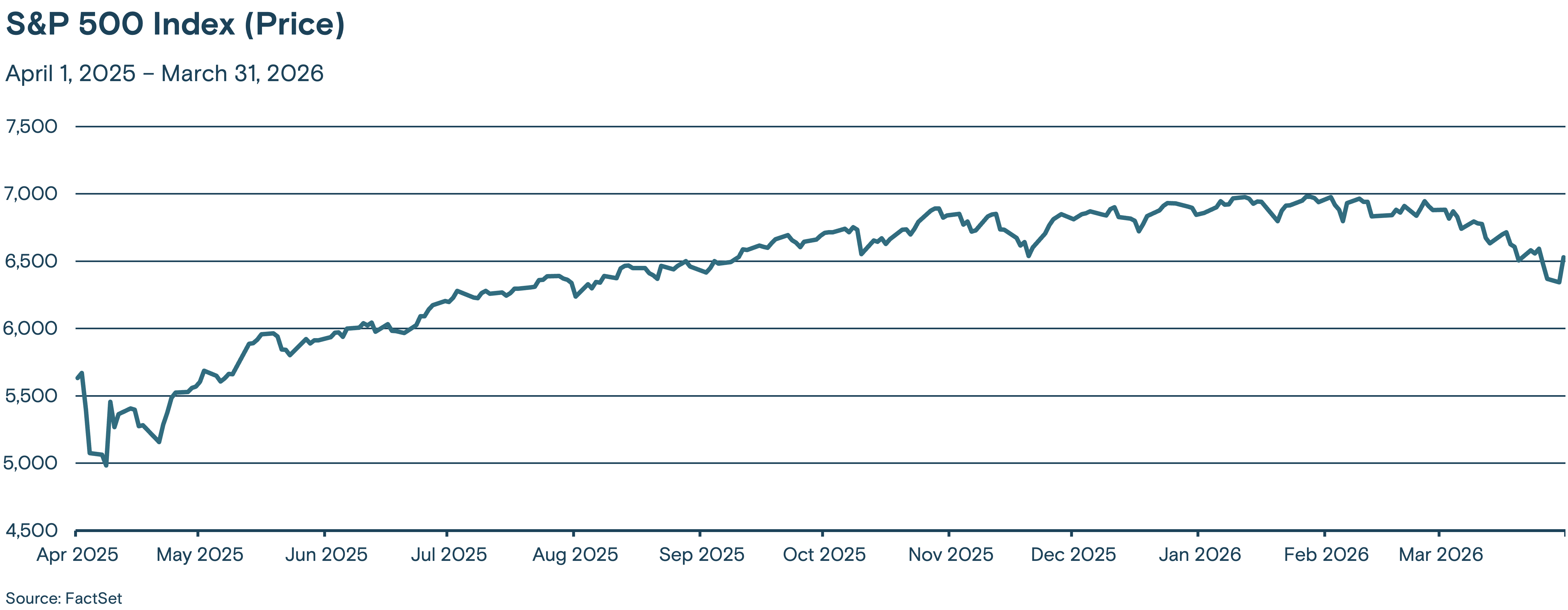
Stocks: The benchmark S&P 500® Index was relatively stable in January and February but declined as the conflict in the Middle East erupted in late March, resulting in a -4.63% year-to-date return. Enthusiasm for value, cyclical and small-cap stocks grew over the period at the expense of large-cap technology companies. The Russell 2000 Index of small-cap stocks posted a positive return for the quarter, rising 0.58%, while the technology-heavy Nasdaq Composite Index fell 7.11%.
Bonds: The events in the Middle East and the resulting rise in oil prices caused Treasury yields to rise across the curve. Longer-dated bonds climbed on fears of higher inflation and larger deficits to fund the war, while shorter-dated yields rose on reduced expectations for near-term interest rate cuts from the U.S. Federal Reserve (Fed). The flood of new bond issuance from large-cap and AI-related technology companies led to some widening in corporate bond yield spreads (the yields paid over comparable Treasuries).
For more on the economy and our outlook for the markets, see: Thrivent’s Q2 2026 market update, Wobbling stocks, stronger bonds, by Chief Investment Strategist Steve Lowe
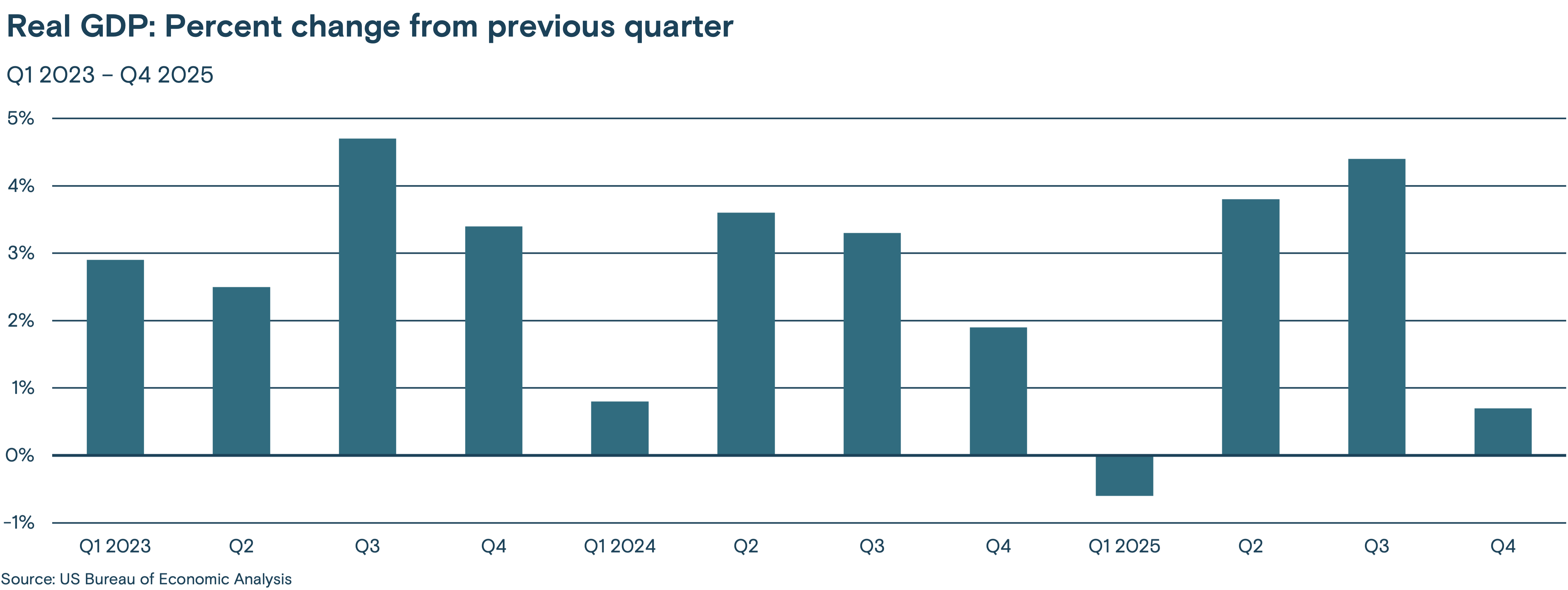
Fourth-quarter gross domestic product (GDP) was revised lower, from 1.4% to just 0.7%, according to Commerce Department data released in March. However, early in the quarter, industrial production improved, business conditions—as measured by the Institute for Supply Management (ISM)—rose and the ISM’s Purchasing Managers’ Index showed encouraging growth in new orders.
Consumers in the upper-income tiers continued to spend in the first quarter, but middle- and lower-income tiers showed signs of greater stress. Consumer confidence fell sharply in January, with The Conference Board reporting that its index fell to 84.5, below the lowest level reached during the COVID-19 pandemic. February’s data showed some improvement in both The Conference Board and The University of Michigan’s surveys, but the rise in oil and gas prices in March raised concerns about future consumption. Retail sales data for February showed a small 0.2% rise from January, below expectations closer to a 0.6% rise.
January’s payroll data was relatively strong (and was revised higher), but February data surprised with 92,000 jobs lost relative to consensus expectations for a gain of 60,000 jobs. While the February data was revised lower, to a loss of 133,000 jobs, the March data surprised again, showing payrolls rose by 178,000, well above consensus expectations. Revisions to the total number of jobs created in 2025 were released in February, and while backward-looking, the revisions were significant, showing that only 181,000 jobs were created during the year, or approximately 15,000 per month. The unemployment rate modestly declined from 4.4% in February to 4.3% in March, largely due to reductions in the labor force.
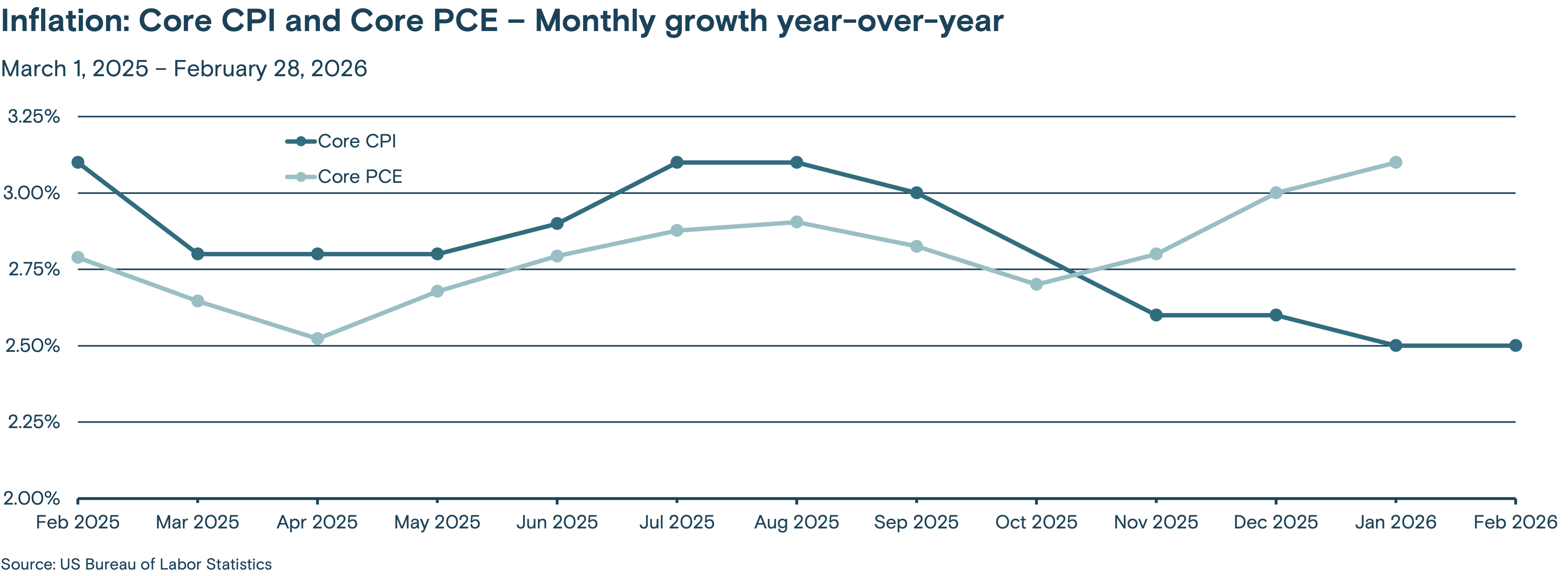
The Core Consumer Price Index (CPI) was relatively stable, near 2.5% over the quarter, in line with expectations. However, the Core Personal Consumption Expenditures (PCE) Price Index, the Fed’s preferred inflation measure, released over the period continued to climb. Core PCE rose 0.4% in January from December 2025 and 3.1% relative to January 2025. Surging oil prices in March added to concerns that upward pressure on headline inflation could be building.
Interest in value, cyclical and small-cap stocks grew over the period at the expense of large-cap technology companies. While the latter continue to generate strong earnings, valuations were high, and their rapidly rising debt exposures raised questions about the extent of their investment and its impact on their cash flows. Meanwhile, their enormous amount of capital spending benefits value, more cyclical and small-cap exposures.
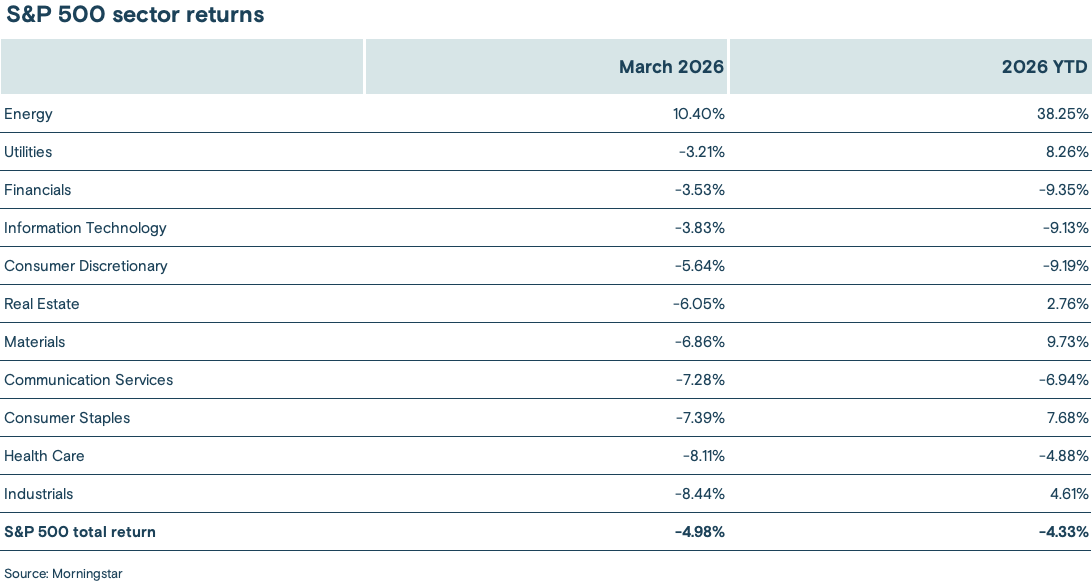
Within the S&P 500 Index, sector dispersion increased. Financials (down 9.35%), consumer discretionary (down 9.19%) and information technology (down 9.13%) led the market lower, while the energy sector, supported by higher oil prices, was up 38.25%, and more defensive cyclical sectors such as materials (up 9.73%), utilities (up 8.26%) and consumer staples (up 7.68%) rallied.
The table below shows the past month and year-to-date performance results of the 11 sectors:
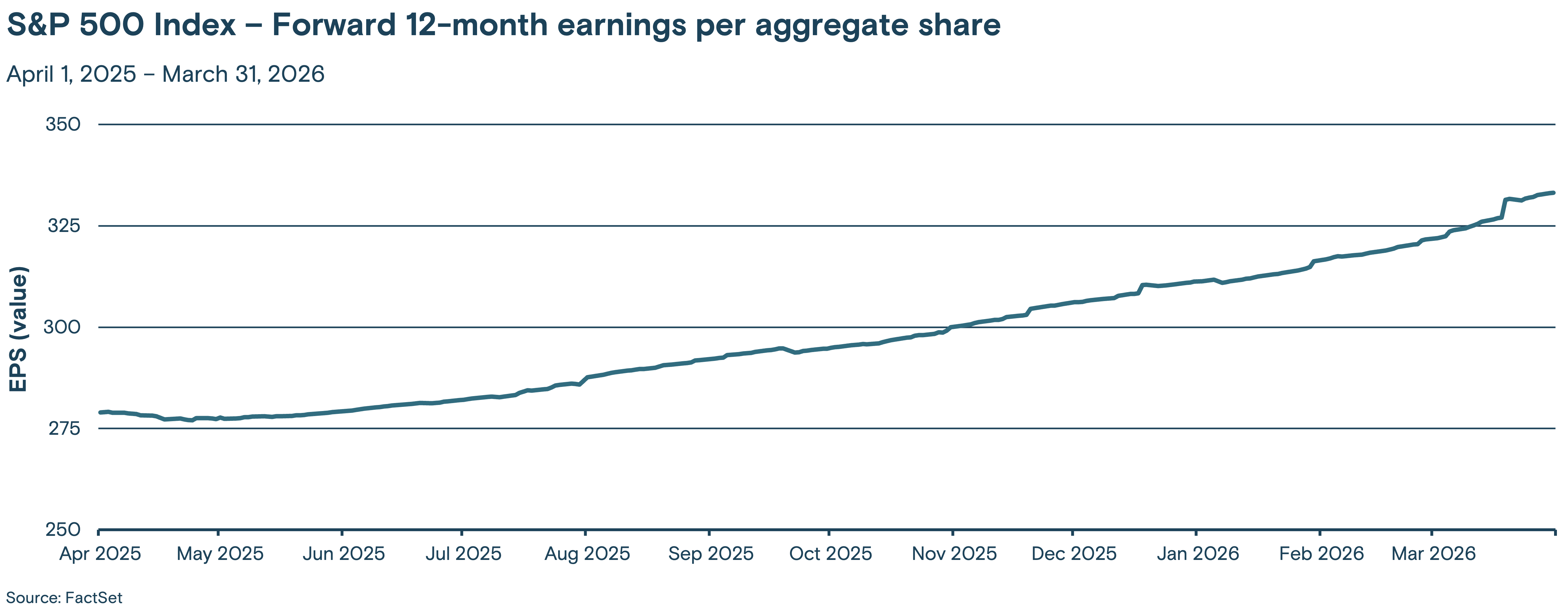
Corporate 12-month earnings projections for the S&P 500 Index continued to climb, rising 7.06% over the first quarter. Strong earnings growth in the technology and communications sectors during the period provided support, while earnings per share (EPS) guidance from U.S. companies continued to rise.
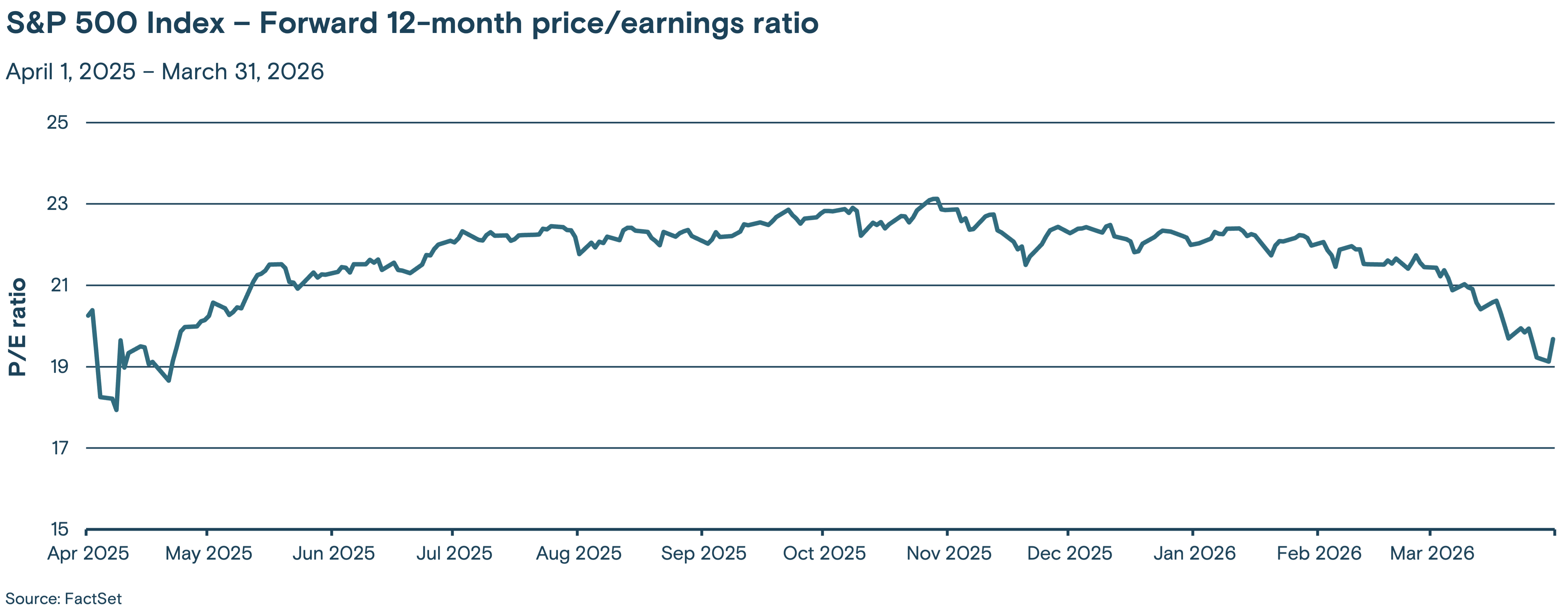
The forward 12-month price-earnings ratio (P/E) of the S&P 500 Index fell 10.53% over the first quarter, from 21.99 at the end of December 2025 to 19.68 at the end of March. A lower P/E ratio means stocks are less expensive relative to their EPS.
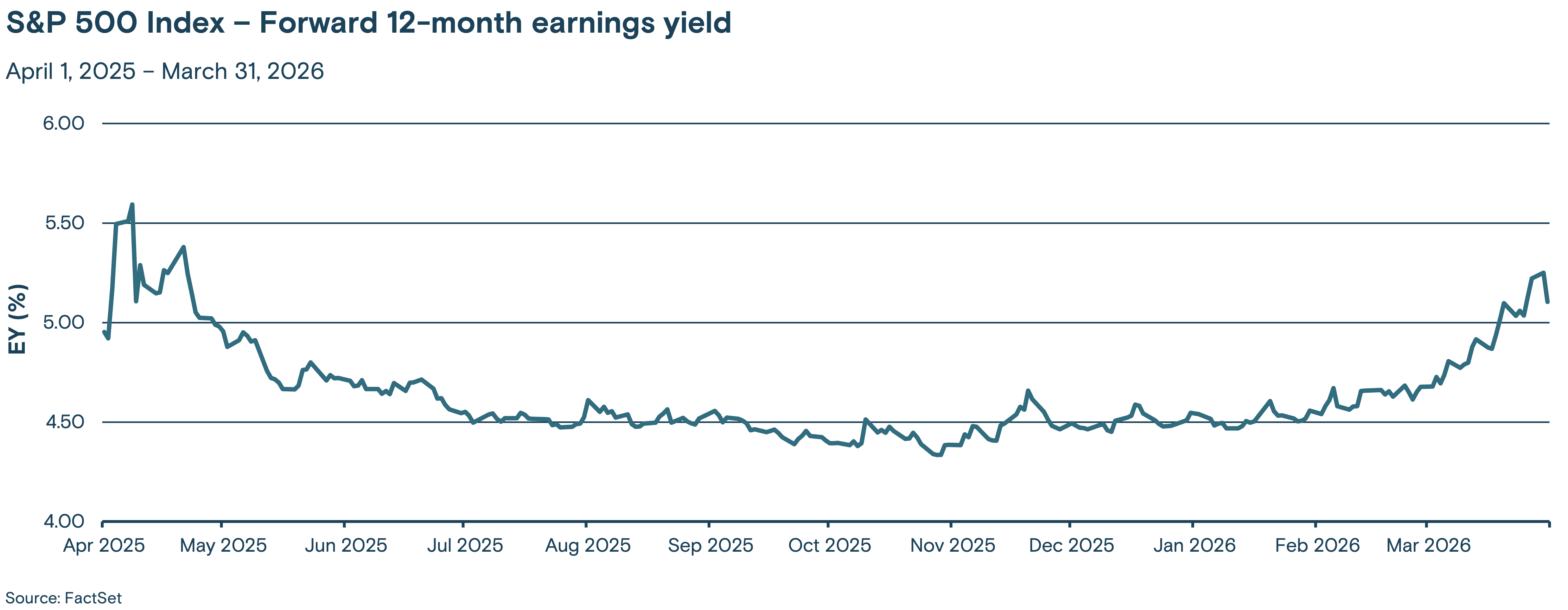
The forward 12-month earnings yield, which is the inverse of P/E, rose over the quarter. At 5.10%, the forward 12-month earnings yield ended the quarter well above the 4.32% yield offered by 10-year U.S. Treasuries. The 12-month forward earnings yield can be helpful in comparing equity earnings yields with current bond yields.
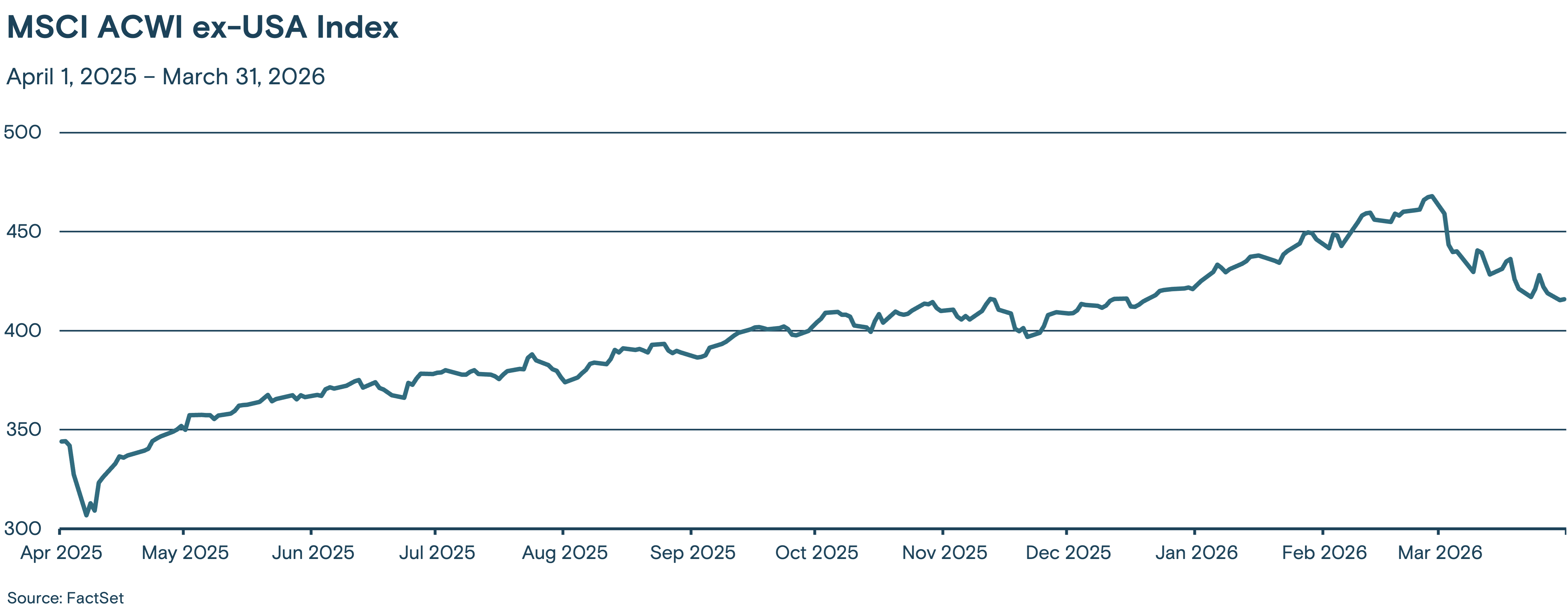
The MSCI ACWI ex-USA Index®, which tracks stocks across developed and emerging-market economies across the world (excluding the U.S.), fell 1.23% over the quarter, outperforming the S&P 500 Index despite a stronger U.S. dollar. Japan’s Tokyo Stock Price Index (TOPIX), which rose 3.6%, was the best performing of the large global equity markets, supported by a weaker yen and February’s election results consolidating power in the ruling party.
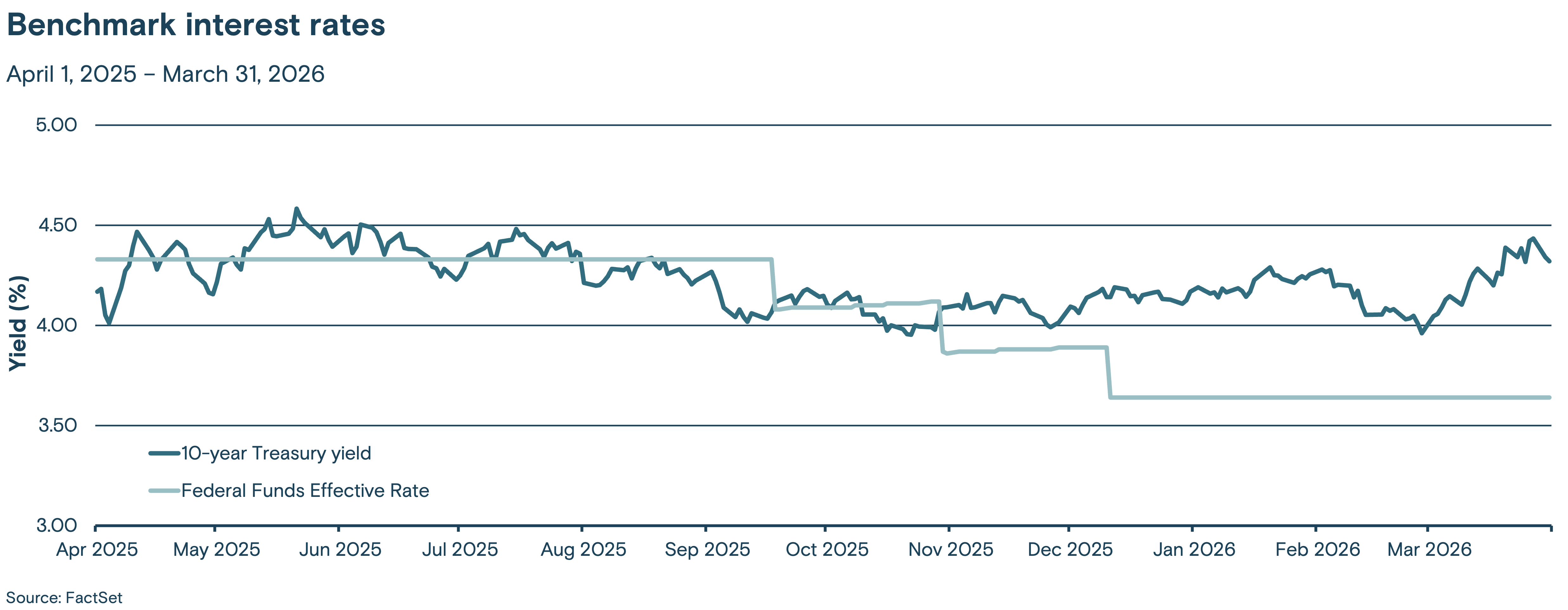
Benchmark 10-year Treasury bond yields rose from 4.17% at the end of last year to 4.32% at the end of March, given significant uncertainty about the duration of the conflict in the Middle East and the effect of higher oil prices on inflation. At its March meeting, the Federal Open Market Committee (FOMC) left the federal funds rate unchanged but maintained its outlook for one rate cut this year. Nevertheless, over the period, the market priced out any further rate cuts for the rest of the year and priced in a small probability of a rate hike.
Investment-grade and high-yield corporate bond spreads widened over the period, largely due to the flood of new issuance from large-cap and AI-related technology companies. Private credit markets were in the headlines, but the market’s largest concerns seemed to center on business development companies (BDCs), which have high exposure to software-as-a-service (SaaS) companies and that artificial intelligence coding tools will negatively impact the software business. The Bloomberg U.S. Aggregate Bond Index fell 0.05% over the quarter.
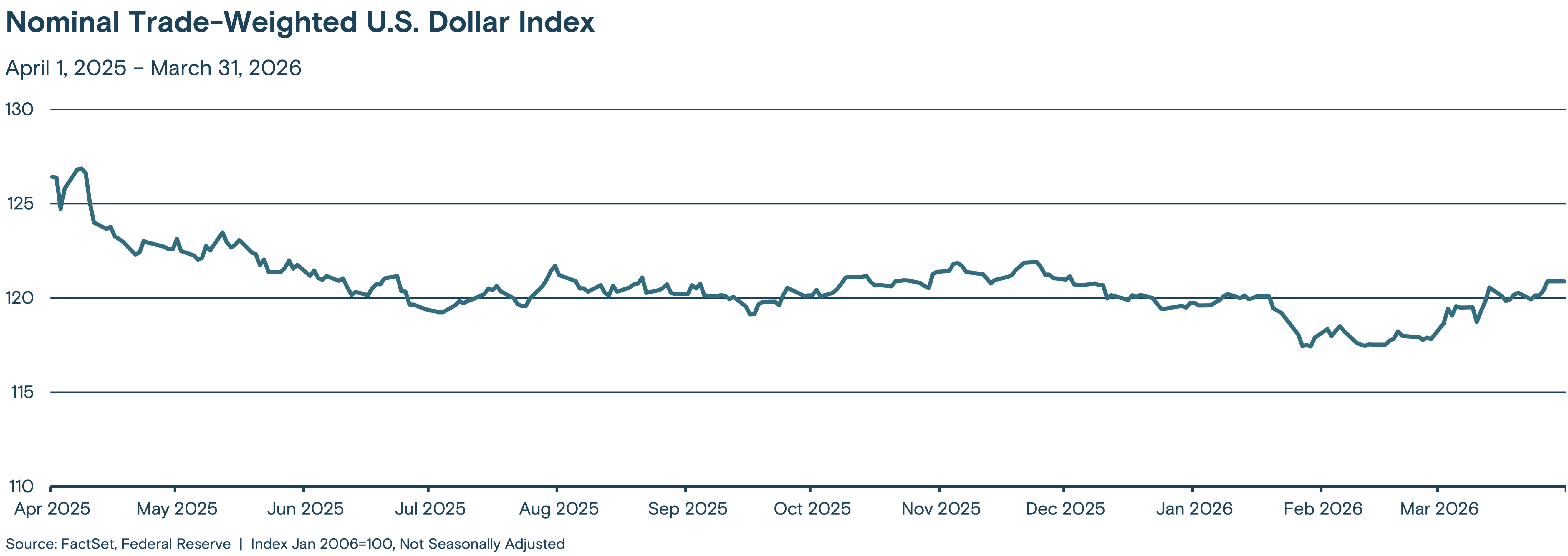
The Nominal Trade-Weighted U.S. Dollar Index rose 0.95% over the quarter. The U.S. dollar was weaker in the first two months of the period amid concerns about economic weakness and the fiscal deficit, pushing the currency to new multi-year lows. But geopolitical tensions arising from the conflict in the Middle East prompted a rebound in the U.S. dollar due to its safe-haven appeal.
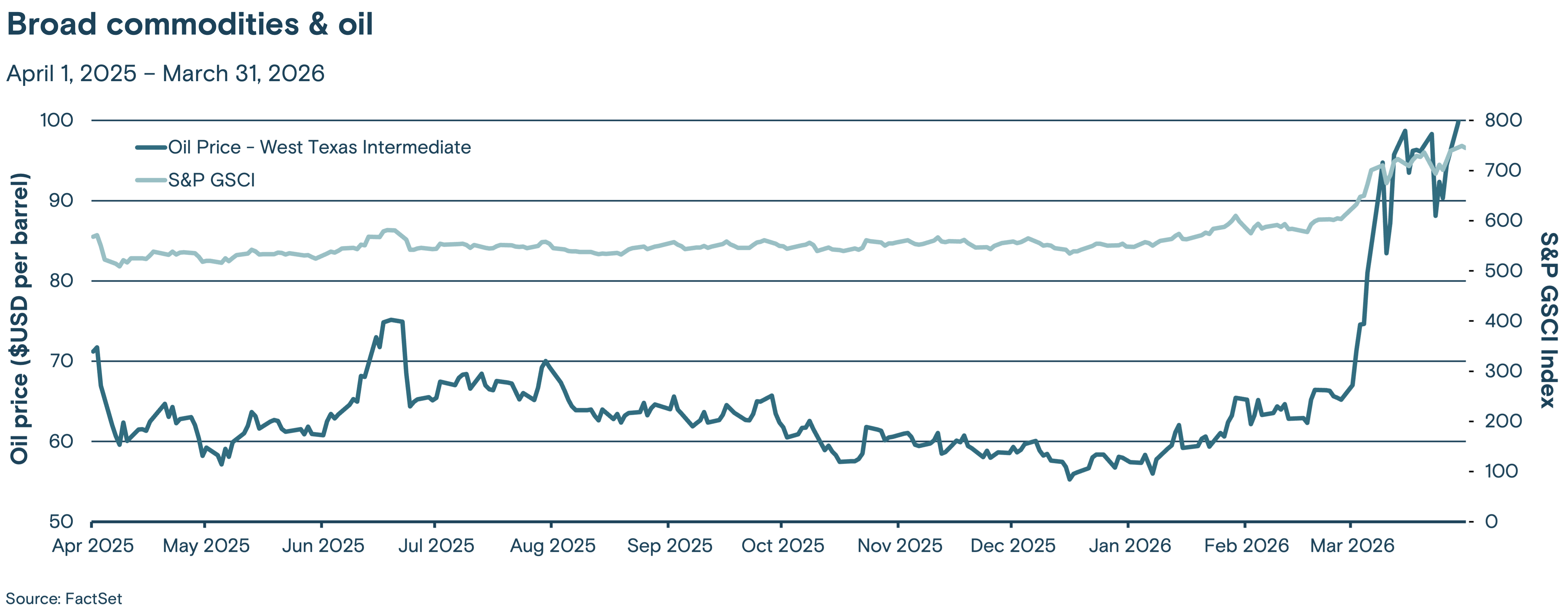
The S&P GSCI Index (a broad-based and production-weighted index representing the global commodity market) surged 35.83% in the first quarter. Oil prices spiked as a result of conflict in the Middle East raising uncertainty, damaging production infrastructure and reducing exports through the Strait of Hormuz. A barrel of West Texas Intermediate (a grade of crude oil used as a benchmark in oil pricing) rose 76.56% over the period. In March, the price of gold declined dramatically (the commodity’s worst-performing month since 2008), largely due to the prospect of higher inflation and higher interest rates.
All information and representations herein are as of 04/08/2026, unless otherwise noted.
The views expressed are as of the date given, may change as market or other conditions change, and may differ from views expressed by other Thrivent Asset Management, LLC associates. Actual investment decisions made by Thrivent Asset Management, LLC will not necessarily reflect the views expressed. This information should not be considered investment advice or a recommendation of any particular security, strategy or product. Investment decisions should always be made based on an investor's specific financial needs, objectives, goals, time horizon, and risk tolerance.
The S&P 500® Index is a market-cap weighted index that represents the average performance of a group of 500 large-capitalization stocks.
The Russell 2000® Index is an unmanaged index considered representative of small-cap stocks.
The Nasdaq Composite Index is a stock market index that includes almost all stocks listed on the Nasdaq stock exchange. The Nasdaq – National Association of Securities Dealers Automated Quotations – is an electronic stock exchange with more than 3,300 company listings.
The MSCI ACWI ex-USA Index is an unmanaged index considered representative of large- and mid-cap stocks across developed and emerging markets, excluding the U.S.
The Bloomberg U.S. Aggregate Bond Index is an unmanaged index considered representative of the U.S. investment-grade, fixed-rate bond market.
The Federal Funds effective rate is the interest rate at which depository institutions (mainly banks) lend reserve balances to other depository institutions overnight on an uncollateralized basis. In simpler terms, it's the rate banks charge each other for short-term loans to meet their reserve requirements.
The Institute for Supply Management (ISM) survey is a monthly indicator of U.S. economic activity based on a survey of purchasing managers at manufacturing firms nationwide.
The Consumer Confidence Index (CCI) is a survey administered by the Conference Board. The CCI measures what consumers are feeling about their expected financial situation, whether that's optimistic or pessimistic.
The University of Michigan Consumer Sentiment Index is a consumer confidence index published monthly by the University of Michigan.
The Core Consumer Price Index (CPI) measures changes in the prices of goods and services, with the exclusion of food and energy.
The Core Personal Consumption Expenditures (PCE) Price Index, also known as consumer spending, is a measure of the spending on goods and services, excluding food and energy prices, by people of the U.S.
The Tokyo Stock Price Index (TOPIX) is a free-float adjusted market capitalization-weighted index tracking nearly all domestic companies on the Tokyo Stock Exchange Prime Market.
The Nominal Trade-weighted U.S. Dollar Index measures the value of the U.S. dollar based on its competitiveness versus trading partners.
Any indexes shown are unmanaged and do not reflect the typical costs of investing. Investors cannot invest directly in an index.
The forward PE ratio uses the forecasted earnings per share of the company over the next 12 months for calculating the price-earnings ratio. It is calculated by dividing the price per share by forecasted earnings per share over the next 12 months.
Earnings yield is the 12-month earnings divided by the share price. Earnings yield is the inverse of the P/E ratio. Earnings yield is one indication of value; a low ratio may indicate an overvalued stock, or a high value may indicate an undervalued stock.
Past performance is not necessarily indicative of future results.